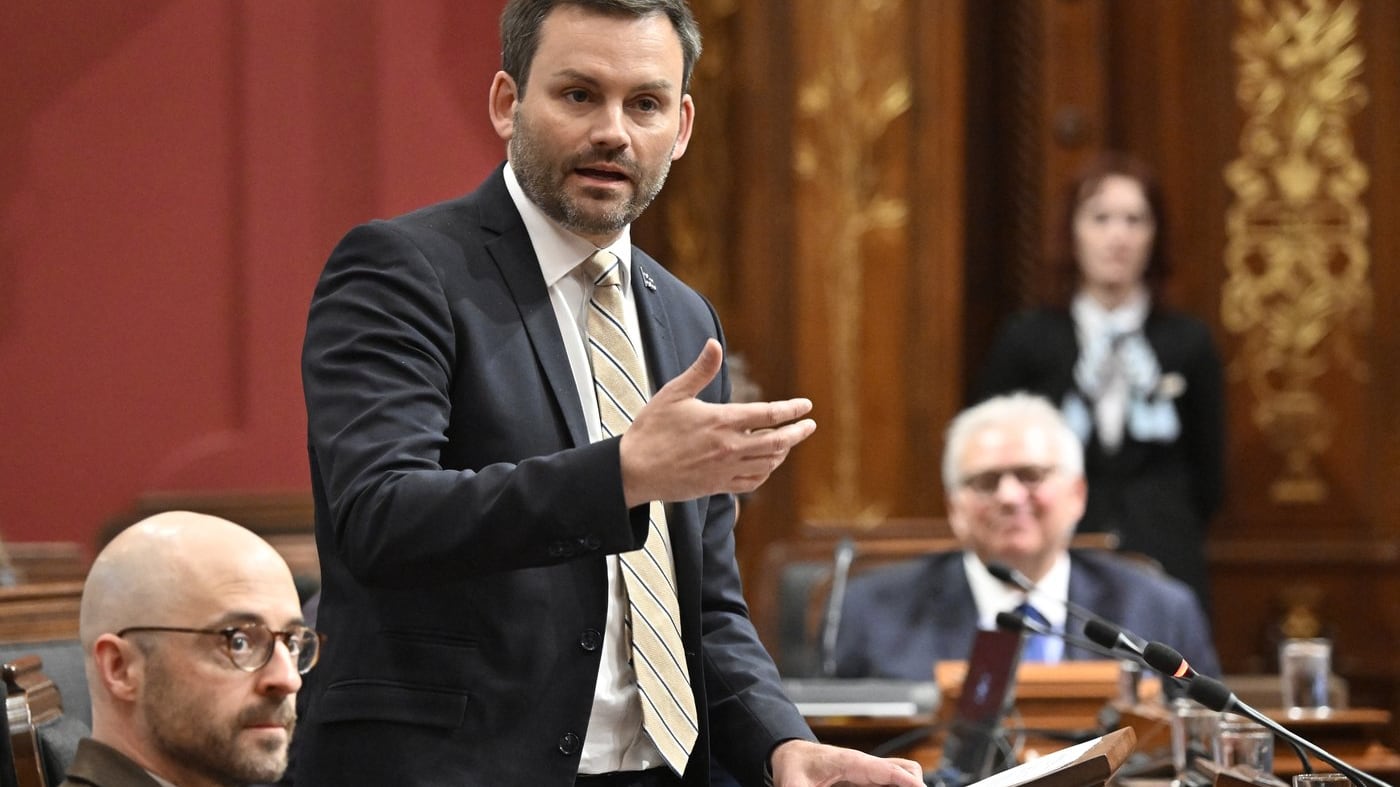
The Parti Québécois is threatening to withdraw Quebec from the The Parti Québécois’ opposition to the federal government’s high-speed rail (TGV) project is now creating unanimous opposition.
The Carney government, the CAQ government, the other parties in the National Assembly and even mayors all denounced the PQ’s position on Tuesday.
According to leader Paul St-Pierre Plamondon, priority should be given to the maintenance of aging infrastructure and if he forms the government, he would ask for Quebec’s share in the project, namely $40 billion, considering that the Bloc Québécois had put forward a total cost of $200 billion.
Quebec City Mayor Bruno Marchand was quick to react after the PQ’s statement.
“The TGV will bring Quebec closer to the major economic and political centres of the continent and will become a powerful economic engine, as has been the case in all G7 countries before us,” he said in a statement sent to The Canadian Press.
“This is a project that will attract investment to all regions along its route — and especially to the National Capital. A country is built around major projects, and to succeed, we need to roll up our sleeves to overcome the challenges associated with them instead of constantly starting from scratch. We’re already behind enough as it is.”
The mayor of Laval, Stéphane Boyer, also expressed his support for the project.
“The TGV is a structuring project that deserves to be studied,” said Transport Minister Benoit Charette in a press scrum.
“We do not endorse it in its current version, because there are many details that remain to be finalized, but we are very interested in seeing the project develop.”
Federal Industry Minister Mélanie Joly praised the project’s qualities and reiterated that the provinces do not have to contribute a single penny to the project.
“Quebecers are ‘fed up’ with seeing that in France it’s possible (to travel by TGV), but in Quebec it’s not possible,” she told parliament.
In a press scrum, PQ MP Joël Arseneau indicated that his party had not consulted the mayors of Quebec’s major cities, who had already expressed their interest in the project.
In a statement, PQ leader Paul St-Pierre Plamondon argues that he cannot “justify to Quebecers that their money be invested in a pharaonic project” when priority infrastructure urgently needs to be renovated.
Based on estimates from the Bloc Québécois, Mr. St-Pierre Plamondon values the project at “potentially $200 billion” and suggests that Quebec’s share would therefore be around $40 billion.
The PQ leader argues that a potential PQ government would demand that Ottawa pay these sums “unconditionally” so that it could invest them in infrastructure such as roads, hospitals, schools and public transit.
“The reality is that if Quebec withdraws, there is no project, so there will be no $40 billion to be found,” warned the parliamentary leader of the PLQ, André Fortin.
While Quebec’s asset maintenance deficit amounts to more than $40 billion, Mr. St-Pierre Plamondon argues that Quebec could renovate “almost all” of its aging infrastructure by receiving its share of the funds that will be allocated to the TGV project.
Mr. St-Pierre Plamondon points out that some studies already warn that the future high-speed rail line may have little impact on road traffic. He argues that the project “is highly likely to be a huge financial fiasco.”
The high-speed rail project, led by the Crown corporation Alto, is planned to connect Toronto to Quebec City, with several stops in Ontario and Quebec cities. Construction of the first segment, between Montreal and Ottawa, is scheduled to begin in 2029 or 2030.
Currently, Alto estimates that the project will cost between $60 and $90 billion, but some experts believe this forecast is unrealistic.
Furthermore, Paul St-Pierre Plamondon asserts that the public consultations conducted by Alto to determine the exact route are “opaque.” He points out that many farmers are worried about “seeing their fields cut in two.”
“Everything is happening as if we want to go as fast as possible before we realize the mistake and the financial fiasco we are heading towards,” the PQ leader denounced in his statement.
He also accuses Canadian Prime Minister Mark Carney of being “more concerned with leaving a legacy project than with the public interest.”
With this statement – which will “not necessarily be popular”, by his own admission – Mr. St-Pierre Plamondon adds his voice to that of the leader of the Bloc Québécois, Yves-François Blanchet, who also opposed the current version of the project.
Patrice Bergeron, The Canadian Press
This report by The Canadian Press was first published June 9, 2026.

