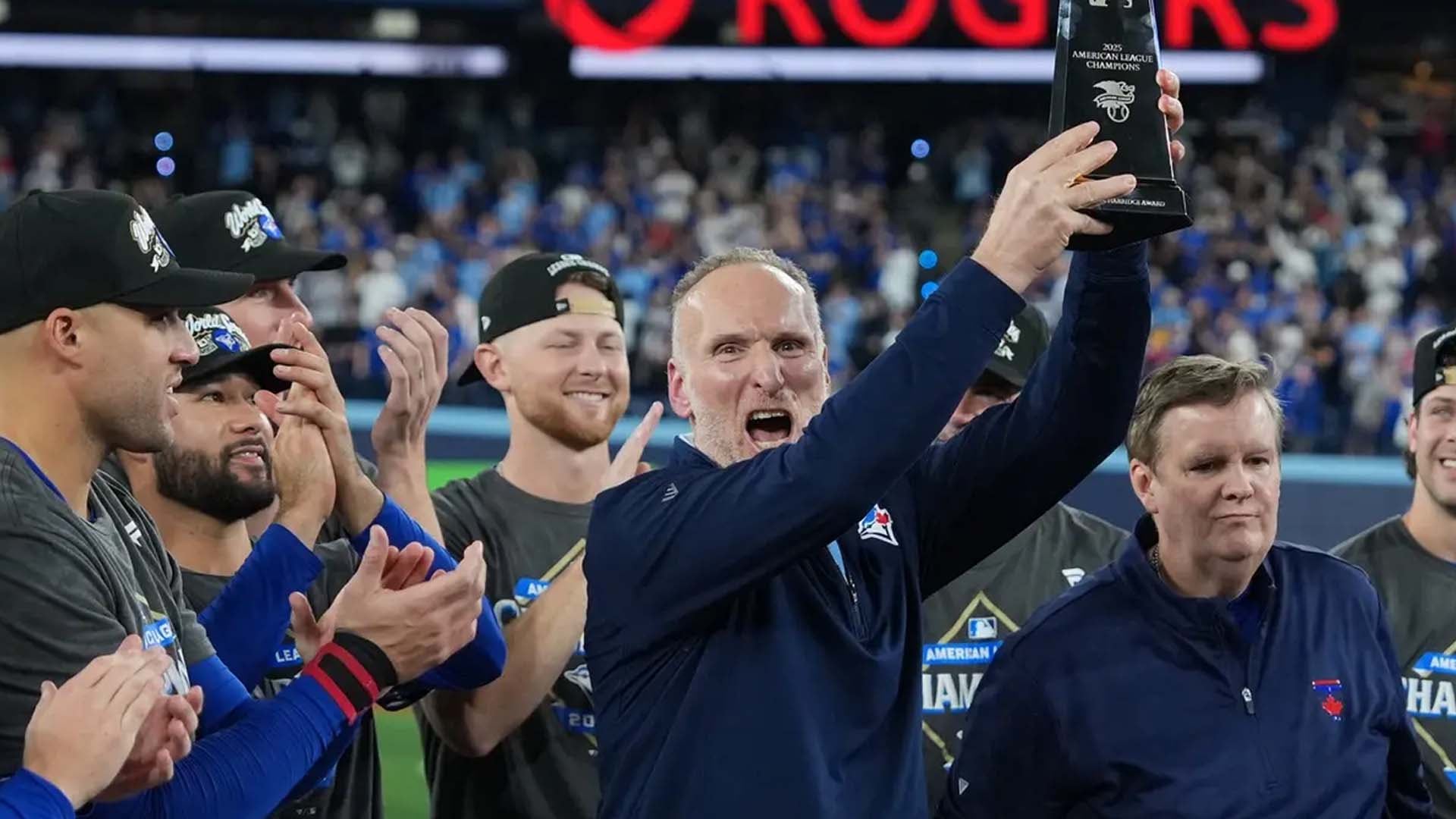
Rogers Centre held its collective breath with little faith left as Alejandro Kirk grounded toward Mookie Betts, who scooped it clean, glided to second base for one, and fired to Freddie Freeman at first. A double-play ball. Two runners erased. The Los Angeles Dodgers, back-to-back champions, piled onto the mound while the Toronto Blue Jays and their faithful sat in stunned silence, the dream swallowed whole by the dome sealing itself against the chilly November night. Thirty-two years, and still counting.
Blue Jays President and CEO Mark Shapiro couldn’t watch the visitors’ celebrations. He turned his back to the field, pulled his kids close, and slipped down to the clubhouse to offer what words he could. Then home. Straight to bed. No highlights. No post-game coverage. Some losses you don’t revisit; you just let them sit in the dark.
By the morning, the city had already reset. Shapiro’s mind had too.
“I woke up the next day, and the only way I could find solace, or think about moving forward, was to get back to the pursuit, to get back to the process, to get back to chasing excellence,” reflected Shapiro in an interview with BNN Bloomberg – his office overlooking the congested Gardiner Expressway and the grey shimmer of Toronto Harbour, a view from a city the Boston-area native has now called home for more than a decade.
Shapiro’s pursuit of excellence isn’t a response to heartbreak. It is a standard he carried across the border in 2015 and has never put down – arriving from the Cleveland Indians (now the Guardians), an organization he spent 24 years with and left as team president.
The Blue Jays looked markedly different back then – a squad built around the lumber of José Bautista, Edwin Encarnación, and Josh Donaldson. Shapiro’s first official day in office came a week after the team bowed out to the eventual World Series champion Kansas City Royals in the American League Championship Series, their first playoff elimination since 1991. The 2015 Blue Jays were the most successful Toronto team since the 1993 World Series champions, and they didn’t need a title to prove it. They gave an entire city permission to believe again – an energy not felt in years.
But building a World Series contender was not the mandate the New Englander inherited. The team on the field was Ross Atkins’ canvas. Shapiro had been brought in by a franchise with ambitions that stretched well beyond the diamond, and the first order of business was the bricks-and-mortar.
“The biggest areas of focus were infrastructure,” said Shapiro. “[In 2015], the Rogers Centre, although an engineering marvel, needed modernizing – from both a fan and player perspective. It was a multipurpose circular stadium with no character, the same dimensions throughout – 52,000 seats, where the only difference was the vantage point. There was no stratification of experience, no way to cater to different segments of the fan base.”
The answer to that assessment was a $500 million, multi-year renovation. The upgrades included raised bullpens, improved seating, new premium clubs and hospitality spaces, an updated outfield wall, and expanded food and beverage offerings.
“The renovation projects were largely fan-amenity focused – with the premium clubs delivering concrete ROI,” Shapiro stated, and the numbers back him up. Prior to the upgrades, the Blue Jays ranked near the bottom of Major League Baseball in premium inventory and revenue, but by 2024 had climbed more than 10 places into the league’s top half, according to Sports Business Journal.
Not every improvement was aimed at the high end of the market. “The redesign of the outfield district now enables us to have $20 tickets, where fans have the freedom to explore all of the Rogers Centre’s renovated experiences,” noted Shapiro.
“For the traditional fan that just wants to sit behind home plate and watch the game, we still have that opportunity – but now with better views and seating throughout the lower bowl that actually faces the field. And fans’ ability to get closer to the field and to the players, whether sitting atop the bullpen or next to a bar rail overlooking the outfield, is an option we simply didn’t have before.”
From groups of young fans on the Corona Rooftop Patio to corporate dinners in luxury suites, the building – once considered a relic of the multipurpose stadium era, outdated almost as soon as it opened in 1989 – has been reimagined to welcome every type of game-goer, broadening its appeal and strengthening demand at the gate.
And that demand translates into ticket sales, which remain the engine of the business, accounting for the largest share of the club’s record USD $445 million in revenue in 2025. For Shapiro, that top-line strength keeps the team competitive while helping offset a structural challenge that hangs over nearly every business investment the Toronto ball club makes: the exchange rate.
Roughly 75 per cent of the club’s revenue is generated in Canadian dollars, while about 75 per cent of its expenses are denominated in U.S. dollars. That built-in friction has long left the organization exposed to currency drag, as the Canadian dollar has historically traded at a significant discount to the greenback.
“It is the single largest challenge we’ve got,” said Shapiro of the exchange rate.
“I evaluate the performance of our organization as if the Canadian dollar were at par. If it were, we would be a top-five revenue team. Instead, we’re middle of the pack.”
Middle of the pack in revenue, perhaps, but not in player spending. Per Spotrac, the Blue Jays’ payroll ranks among the top five in MLB.
“The money the club makes obviously goes back into the team and toward putting the best possible product on the field.”
The spending doesn’t stop with salaries. In addition to overhauling the team’s clubhouse during the Rogers Centre reconstruction, Shapiro also oversaw a major renovation of the Blue Jays’ spring training complex in Dunedin, Florida – a $100 million project completed in 2021 that is now regarded as one of the best facilities in the league.
“Our spring training facility needed to be upgraded. It was among the worst one or two in the league when I got here,” Shapiro said.
“In this business, it’s analogous to attracting and retaining talent, and then putting that talent in an environment where it’s most likely to achieve its best output.
“We think about player performance with every corner of every facility – the best nutrition to sustain their energy on the field, the best recovery modalities like nap rooms, float tanks, hot and cold plunges – everything we can do to help them recover in a game that demands it, 162 times a year.”
The cost of that ambition is reflected in the club’s financial results. Operating income sat at USD $71 million in the red in 2025, marking a sixth consecutive year of losses. Meanwhile, the franchise’s valuation has continued to climb, reaching USD $2.5 billion, according to Forbes.
The bricks-and-mortar investments only tell part of the club’s growth story. Shapiro is the first to say that winning remains the single most powerful lever, with ripple effects across every revenue stream. It drives attendance first – the Blue Jays doubling their season-ticket base off the high of their World Series run – while also boosting corporate partnerships, with the team adding 20 new partners this year, bringing the total to 80.
“Corporate partnerships are the second-highest source of revenue for us within our portfolio. Around 20 to 25 per cent of our revenue comes from that segment,” Shapiro noted.
The roster features major Canadian and international brands across a range of industries, including TD Bank, Adidas, Pizza Nova, and WestJet, to name a few.
“TD is the big one,” stated Shapiro.
TD Bank has been a Blue Jays partner for over two decades – a relationship that spans exclusive in-stadium perks for credit cardholders, premium spaces, prominent branding across Rogers Centre and TD Ballpark in Florida, and community initiatives through the Jays Care Foundation supporting youth baseball across Canada.
“We work hard to live up to the word partnership. We’re not just collecting money and printing a sign, but trying to think about how we activate and promote their brands in our ballpark in a way that elevates them, increases sales, and ultimately makes the association with the Blue Jays a more powerful one,” said Shapiro.
Perhaps no company felt the lift of the Blue Jays’ success more acutely than Rogers Communications – the Canadian telecom giant that has owned the team outright since 2004 and sits at the heart of the club’s third-largest revenue driver: media.
Shapiro runs the day-to-day with autonomy, but major infrastructure and player investments still require Rogers’ approval. It’s a relationship that has worked both ways. The parent company’s backing spurred the rebuild, and the Blue Jays’ World Series run last year sent stronger revenue flowing back up the chain.
The Blue Jays’ push to Game 7 doubled Rogers’ media revenue in the fourth quarter of 2025 – from $547 million to $1.24 billion.
An average of 10.9 million viewers tuned in for the final game across Sportsnet, Sportsnet+ and Citytv. The full World Series averaged 7.5 million viewers, with 23 million Canadians watching at some point. In other words, just over half of the country was along for the ride. Game 7 also became the most-watched broadcast in Rogers history and the most-watched Canadian broadcast outside the 2010 Winter Olympics.
Yet that same Game 7 was a reminder that none of it – the revenue records, the transformed building, the box-office clubhouse, the country that couldn’t look away – adds up to the only thing that has ever truly mattered. A decade in, the one thing Mark Shapiro came here to do still remains undone – deliver the franchise its first World Series title this century.
Though unlike years past, the pursuit is no longer just about relevance. The foundation is laid on and off the field. A city’s belief has been reignited, electric in a way not felt since Shapiro first walked through the door on Halloween Day in 2015. What ended in stunned silence, by the finest of margins, merely months ago now feels uncomfortably close to changing. In a ballpark that has already held its breath once, Toronto is no longer wondering if, only when.
Follow Aleksa Cosovic on Instagram and X: @aleksa_cosovic

