It was almost too easy to make the comparison between these NBA Finals and the championship series in 1999, the last, and only previous time, the New York Knicks faced the San Antonio Spurs for the league title.
Where the game had come in that time, how much the sport had grown worldwide, how much the league had flourished, and how expansive earnings had become.
The ratings for Game 1 dwarfed Game 1 of last year’s Finals by 90% in the USA, and it was the highest rated game since Game 6 of the 2019 Finals, according to NBA.com.
Sure, New York was playing, and that market alone breathlessly turned on televisions in droves. But to casual and diehard fans alike, the chance to watch Victor Wembanyama was too alluring to pass up.
The brilliant 22-year-old, 7’4” Frenchman is the new face of the NBA, and he will be presumably for the next 15 years, barring serious injury.
This isn’t just a phenomenon in North America, it’s big news in Europe. With standard media reporting, but not enormous fanfare, the commissioner of the NBA and the general secretary of FIBA – the sport’s international federation – used the day of Game 1 to definitively assert that NBA Europe is a reality, and will launch in October of 2027.
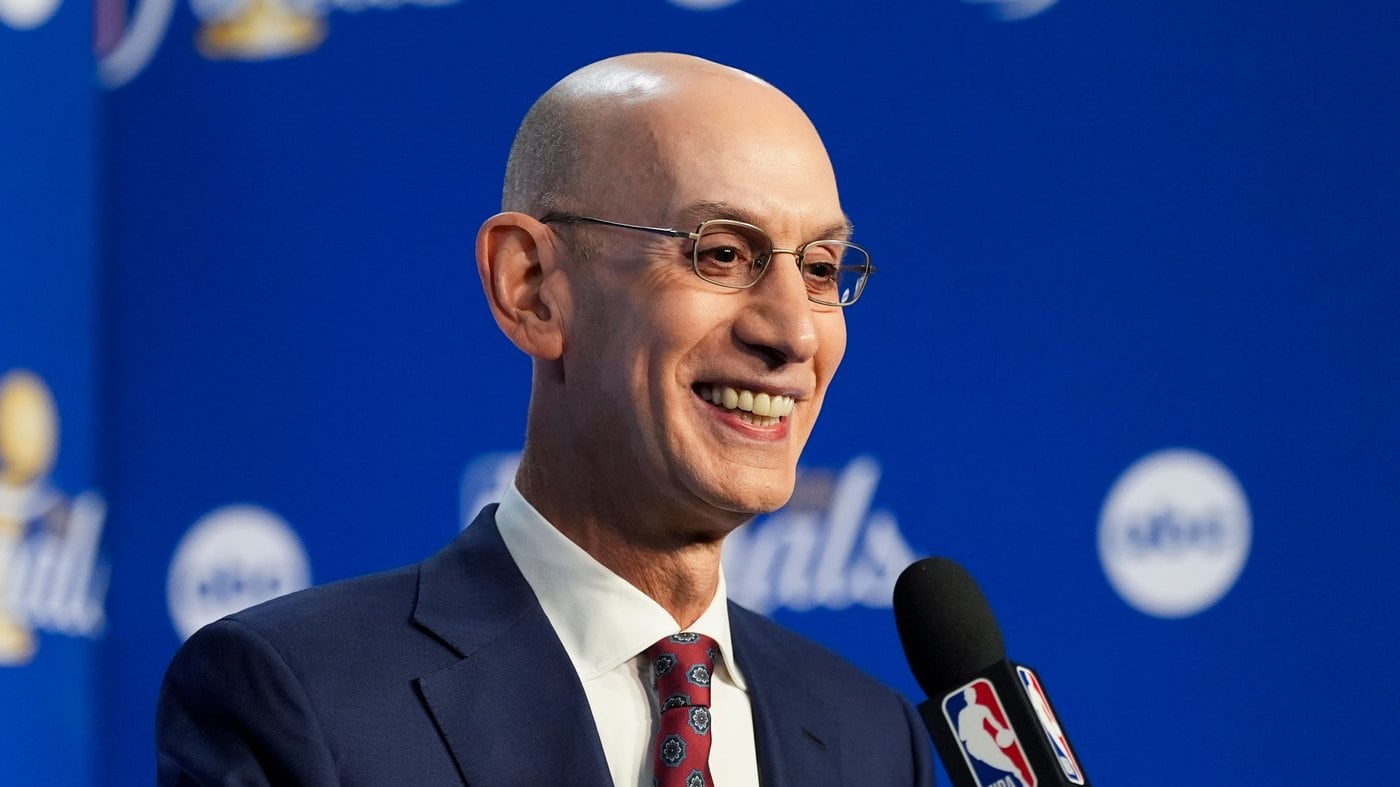
In his annual NBA Finals press conference, NBA commissioner Adam Silver said: “It is our hope and anticipation that that league will launch.
“We are on track.”
He told reporters there will be 16 teams, 12 of which will be permanent with room for more teams able to move up and down. Four open spots would offer every team in a FIBA-affiliated domestic league in Europe a merit-based pathway to qualify on an annual basis either through FIBA’s Basketball Champions League (BCL) or an end-of-season qualifying tournament. These four teams would have to earn their spots each year and could not become a permanent member.
According to Yahoo Sports the target cities for the permanent teams include London and Manchester in England, Paris and Lyon in France, Rome and Milan in Italy, Madrid and Barcelona in Spain, Berlin and Munich in Germany, as well as Athens and Istanbul.
In discussing the four slots that will be up for grabs each year, FIBA general secretary Andreas Zagklis said, “One of the key and new elements of the project that is a clear and fundamental piece of the plan is that the teams that qualify for the competition will have equal starting revenue and equal access to performance-related revenue with the franchises. You win your right [to play], and you can afford this right. This is fundamental to us, not only to attract the investments we are seeing now in the bidding process for the franchises, but also to attract other investors in the clubs that play in the domestic leagues and Basketball Champions League every year to qualify and play in the top league.”
Sportcal stated that “the NBA has received multiple bids in the USD $500 million to $1 billion range, including several above $1B.”
The league is closing the bidding process at the end of June and expects to announce NBA Europe franchises by autumn.
There are two key basketball orgs in Europe that have been pivotal in professionalizing the sport across the continent. FIBA, which is clearly on board with the NBA, and the EuroLeague, whose involvement with an NBA league is more murky. The NBA business could compete with the generations-old EuroLeague, a partially closed championship between 20 teams, 16 of which have long-term licences.
There are strong arguments that there will be room for both the NBA and EuroLeague to flourish side by side, with a door open for collaboration. EuroHoops quoted a star player from Hapoel Tel Aviv, 7-year American pro Elijah Bryant, a member of the 2021 NBA champion Milwaukee Bucks: “The NBA brings what European basketball has never had at scale. Capital, a global distribution machine, and decades of turning a sport into a business.”
“The EuroLeague brings the part money cannot buy. A product that is already real. Rivalries that go back generations. Buildings where every game feels like it matters.”
EuroHoops expects minimum revenues for each club in NBA Europe to be 8 million Euros per season, or close to CDN $13 million. This would be generated by the NBA affiliation, its marketing machine and worldwide sponsors who have profited as partners for years, even decades. Shoe deals will have new meaning with European stars playing in Europe, but with the NBA logo. Soda, energy drinks, auto … all to pony up for their association with the Association.
Insider Sport wrote that “NBA Europe bidders lodged more than 120 bids last March,” and listed RedBird Capital, owner of AC Milan, and former Tottenham Hotspur Chairman Daniel Levy as interested team owners. The report also maintained that “permanent franchises will be able to benefit from expansion proceeds, with valuation proceeds being diluted rateably.” No wonder so many want in at the ground floor.
“The NBA plans to invest more than USD $3 billion in support of the European league in a bid to reduce early-stage risks and build a path for future profitability,” according to the Insider Sport story.
The future is now for NBA expansion. While still eons away from catching its rival NFL for domestic revenue generation, it is overseas where basketball has an advantage. The game is played all over the world, with domestic pro leagues existing across the globe, a luxury American football doesn’t have. An attempt at NFL Europe faded away after an on-off operation between 1991 and 2007. The NFL plays meaningful games around the world, but international NFL teams don’t resonate the way it will for basketball clubs.
With players like Wembanyama, Serbia’s Nikola Jokic, Slovenia’s Luka Doncic and Greece’s Giannis Antetokounmpo dominating basketball at present, on the court and in the headlines, NBA Europe has new meaning. It’s been a full generation since the 1992 Barcelona Olympics when the Dream Team brought the sport to the world. The cultural shift in basketball is long underway making the time right for NBA expansion to Europe. The profit will accompany it.
Follow Dan Gladman on Instagram and Blue Sky: @dgontheroad

