More than a year before the World Cup, Canadian sports stores placed what they thought was a safe bet on Italy’s national soccer team.
As one of the few teams to win four World Cups, the Azzurri are in a rare club. Even though they failed to qualify for the last two tournaments, their Euro 2020 win and an expansion of this year’s World Cup field to 48 from 32 teams gave Canada’s sizeable Italian community hope.
So sports stores ordered merchandise accordingly. Then came the big letdown: the Italians failed to qualify.
Suddenly, a team that’s usually a cash cow for Canadian sports shops had turned into a burden. Along with other non-qualifiers like Denmark, Nigeria, Jamaica, Poland and Northern Ireland, it became a reminder of just how unpredictable the game can be.
“Italy not making it definitely hurts us,” said Carmelo Sansalone, whose family has run the Evangelista Sports store in Montreal since 1985.
“We’re based in Little Italy. We have a huge Italian community, so yeah, that put a dent in our sales for sure.”
With demand for Italian gear far lower than predicted, the shop is among many across Canada that have significantly marked down the team’s merchandise.
Italy jerseys that it would have sold for $190 each are now available for $95. Sansalone expects it will take months to sell through all the inventory for teams that didn’t advance — a stark comparison to the Canada and France gear that’s flying off his shelves.
“Some gambles work out, some gambles don’t,” he explained.
It’s a lesson even the big sports stores appeared to be feeling at the Eaton Centre mall in Toronto last week. While shoppers were hurriedly picking up Canada jerseys as well as merchandise for top contenders France, Spain and Argentina, paraphernalia for teams not in competition barely got a glance.
At JD Sports, racks of Italian and Jamaican jerseys were marked $50, down from $100. Northern Ireland jerseys were going for $60, a drop from $120 originally.
Over at Sport Chek, shoppers were greeted at the entrance with a clearance rack stuffed with half-priced Italy and United Arab Emirates wear all marked down by at least 50 per cent.
Dylan Rowe, head of retail at Ontario sportswear chain Soccer World, said the reason why there’s so much merchandise to sell is because sports shops have to order their World Cup inventory long before the tournament’s participants have been decided, so it can get manufactured in time.
Many didn’t just buy “heavily into Italy,” they doubled down.
That’s because they knew if Italy qualified, they would have plenty of buyers to satisfy.
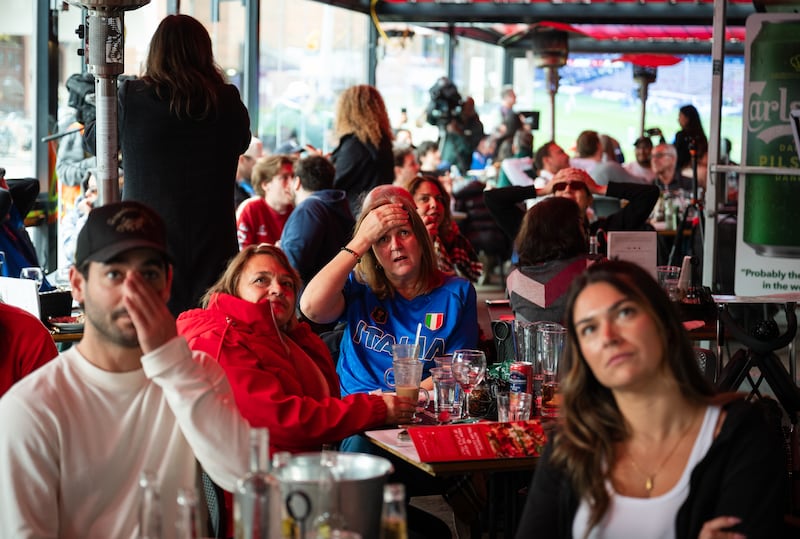
More than 1.5 million people in Canada reported Italian heritage to Statistics Canada in 2021 and the fan base is so fervent, Rowe said the team’s jerseys are usually among his shop’s three most popular.
When a tentative World Cup schedule was drawn up in November, it showed Italy could wind up playing in Toronto, if the team made it to the tournament.
“Everyone bought even more inventory at that point as well,” Rowe said.
Then, things went sideways. Italy crashed out of qualifying during a penalty shootout loss to 66th-ranked Bosnia-Herzegovina.
“Obviously, it’s tough,” Rowe said.
His shop has joined others in marking down Italy jerseys and hoping the country fares better when the women’s World Cup is hosted next year in Brazil.
Luckily, Rowe and Sansalone have seen demand for other team’s merchandise soar.
At Evangelista Sports, Montrealers are clamouring for France, Portugal, Morocco and Algeria jerseys and at Soccer World Central, Germany’s offering was a hit in the lead up to its faceoff against Ivory Coast in Toronto.
But the real star has been the home team, which earned its first-ever World Cup point in a mid-June match against Bosnia-Herzegovina and notched a monumental win against South Africa on Sunday to advance to the round of 16.
“We’ve sold more Canada shirts now than we ever have as a business for 25 years, so it’s been insane demand for Canada jerseys,” Rowe said.
“Some of it is from Italian Canadians. I have friends that are now pouring all that support into Canada.”
This report by The Canadian Press was first published June 30, 2026.
Tara Deschamps, The Canadian Press

