


Energy and Natural Resources Minister Tim Hodgson is promising the new Pacific Link oil pipeline to the West Coast will get built, regardless of potential future market shifts and geopolitical changes.
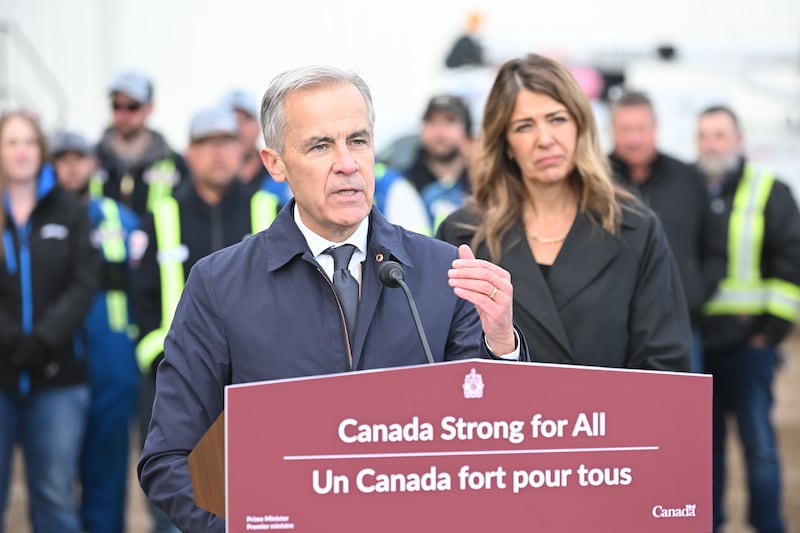
On Thursday, Prime Minister Mark Carney and Alberta Premier Danielle Smith announced the Pacific Link pipeline will be the first officially designated national interest project under the Building Canada Act.
The designation is meant to speed up the process of building the pipeline, with both the premier and prime minister setting a September 2027 timeline for construction to get underway.
Carney on Thursday also insisted: “The Canadian taxpayer is going to make a lot of money off this pipeline.”
In the meantime, taxpayers are footing much of the bill for the pipeline, despite promises it needed a private backer. According to a government official in a technical briefing ahead of the announcement on Thursday, the early process is estimated to cost $4 billion between the two levels of government.
The Pembina Pipeline Corp. has expressed interest in a 10 per cent private sector stake and has the option of up to another 10 per cent once the pipeline is in operation.
In an interview on CTV Question Period airing Sunday, host Vassy Kapelos asked Hodgson why Canadians should trust that the pipeline will get built when the prime minister said less than a year ago it would not go forward without a private proponent.
“We’re in the middle of the worst energy crisis in the history of the modern world, as defined by the International Energy Agency (IEA),” Hodgson said, adding he thinks “Canadians understand a lot has changed in the last year.”
“That was all really brought on by a war that had not started a year ago,” Hodgson also said. “We are in a very different world today. The Trans Mountain Expansion Project (TMX) has proven to be a very good investment for Canadians, and I believe this project will be as well.”
Hodgson then pointed to the number of foreign markets that have expressed an interest in Canadian oil.
When pressed by Kapelos on the federal government’s commitment to the Pacific Link pipeline — considering geopolitical contexts are constantly changing and many European markets remain committed to transitioning away from conventional energy — Hodgson said his impression from the president of the IEA is that “demand for oil to continue well into the future.”
Pressed again on much of Europe’s commitment to reaching net zero and how that could affect the demand for Canadian oil down the line, Hodgson said: “I think the market will speak.”
“The proponents here will have an open season, likely next spring, and in that open season, shippers will be asked to commit to long-term contracts to take oil over that pipeline,” he added.
If shippers do not commit to the pipeline, Hodgson said: “We’ll deal with that at the time.”
“But if I were a betting person today, looking at what we’ve just seen happen on the TMX, where shippers increased their contracted portion of the pipeline, and where I hear from everyone (that) they would like more, if I were a betting person, I think that’s a pretty good bet for the Canadian taxpayer,” Hodgson said.
Hodgson reiterated the prime minister’s election promise to turn Canada into an energy superpower, saying the federal government is “highly confident” that’s the best path forward for the country.
“The good news is there are shovels in the ground,” Hodgson said, pointing to two other projects that are currently underway, such as the 89-kilometre Taylor to Gordondale pipeline to move diluent from British Columbia to Alberta, and the $4-billion Sunrise pipeline expansion.
“We are building pipelines, and we will build this pipeline for the people of Canada,” Hodgson insisted.
You can watch Energy and Natural Resources Minister Tim Hodgson’s full interview on CTV Question Period Sunday at 11 a.m. ET.
With files from CTV News’ Rachel Aiello

