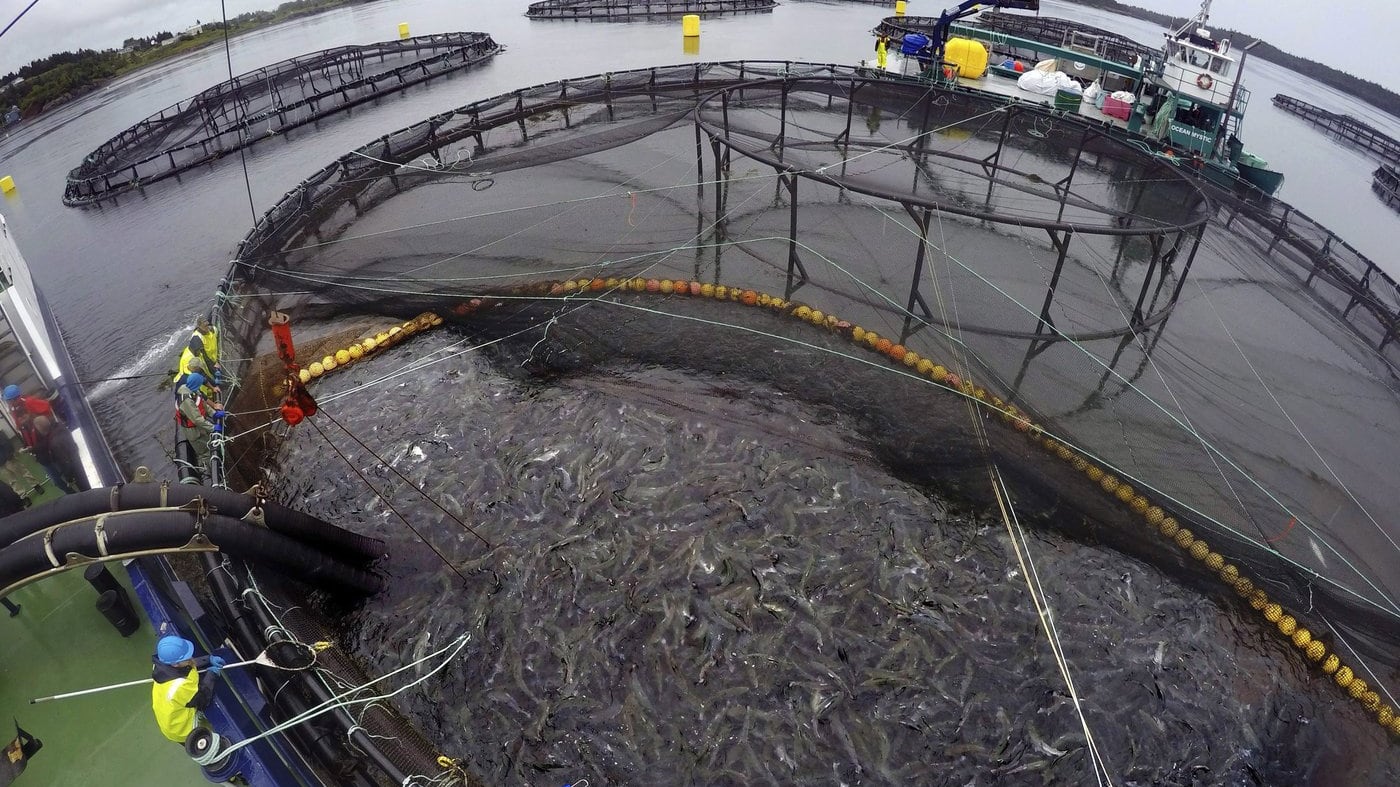
SAINT JOHN — One of Canada’s largest seafood companies has struck a $225-million deal to grow its salmon business in the Atlantic region.
Cooke Inc., based in Saint John, N.B., says it has agreed to acquire the salmon farming assets of Mowi Canada East, whose Norwegian parent company -- Mowi ASA -- describes itself as the largest salmon farmer in the world with about 20 per cent of global market share and record revenue last year of 5.7 billion euros.
The deal, set to close by the end of the year, involves operations in New Brunswick, Prince Edward Island and Newfoundland and Labrador. Cooke says the sale includes freshwater hatcheries, sea farming sites and two processing plants.
“This is an exciting growth opportunity for our Atlantic Canada operations,” CEO Glenn Cooke said in a statement.
“We look forward to welcoming Mowi Canada East’s 250 employees to Cooke, and to working together to grow the sector and sustainably farm Atlantic salmon for customers in this region and beyond.”
Publicly traded Mowi ASA says it will take a $140-million writedown in connection with the sale of the assets, which were besieged by several salmon die-offs last year.
In July, the company reported an “abnormal mortality event” that saw more than 10 per cent of the Atlantic salmon die at a site near Rencontre East, on Newfoundland’s south coast about 190 kilometres west of St. John’s. In September, about 23 per cent of the fish died at three more sites near Harbour Breton, N.L., also on the south coast, due to cold, and low-oxygen water swelling to the surface.
In the fall, the company reported 475,000 more salmon deaths caused by sea lice at two other Newfoundland sites, triggered by high temperatures and a lack of rain and wind to drive ocean currents.
The firm’s 2025 annual report said it lost 39.8 million euros before interest and taxes on its Canadian salmon last year, compared to a 3.4 million euro profit in 2024. Production from its eastern operations were expected to slide from 17,000 tonnes to 12,000 tonnes this year in relation to the die-offs.
Mowi ASA said in a statement that it was selling the assets “in order to further improve Mowi’s farming portfolio and focus even more on core farming geographies.” It declined further comment Tuesday.
Sister company Mowi Canada West has also faced challenges, including the federal government’s 2024 decision to phase out traditional ocean-based salmon farming in favour of land-based operations by 2029 on the British Columbian coast.
“Consequently, Mowi Canada West is a (20,000 tonne) operation with highly uncertain future prospects,” the company said in its annual report.
Cooke said it plans to continue investment in rural communities across the Atlantic region. “Our immediate objectives will be to stabilize and reinvest in the operations through synergies with our existing farming operations across Atlantic Canada,” Glenn Cooke said.
Ottawa is not considering a phase out of ocean farming on the Atlantic coast, but the aquaculture industry has faced its share of controversy nationally.
Many environmentalists consider open net farming to be a riskier method of aquaculture compared to land-based farming because there is free exchange between the outer environment and the farm, increasing risk of contamination from waste, disease and potential escapes.
In a 2018 report, Julie Gelfand, who was federal environment commissioner within the auditor general’s office, had warned of the disease risk that farmed fish pose to wild salmon, finding that Fisheries and Oceans Canada had not adequately balanced the industry’s risks with its mandate to protect wild fish. The report pointed to a lack of research on the effect of pesticides and the risk of salmon escapes, which can lead to genetic defects in wild populations.
Cooke was founded in 1985 by Gifford Cooke and his sons, Michael and Glenn. The business has grown through more than 100 acquisitions since its founding.
Its largest deal came in 2022 when it took over Australian seafood producer Tassal Group Ltd. in a $1.5-billion transaction. The same year, Glenn Cooke became an investor in Ganong Bros., Ltd., Canada’s oldest candy and chocolate company, headquartered in St. Stephen, N.B.
Cooke Inc. now bills itself as the largest private family-owned seafood firm in the world with a staff of 15,000 across 16 countries.
This report by The Canadian Press was first published June 30, 2026.
By Devin Stevens in Halifax.

