


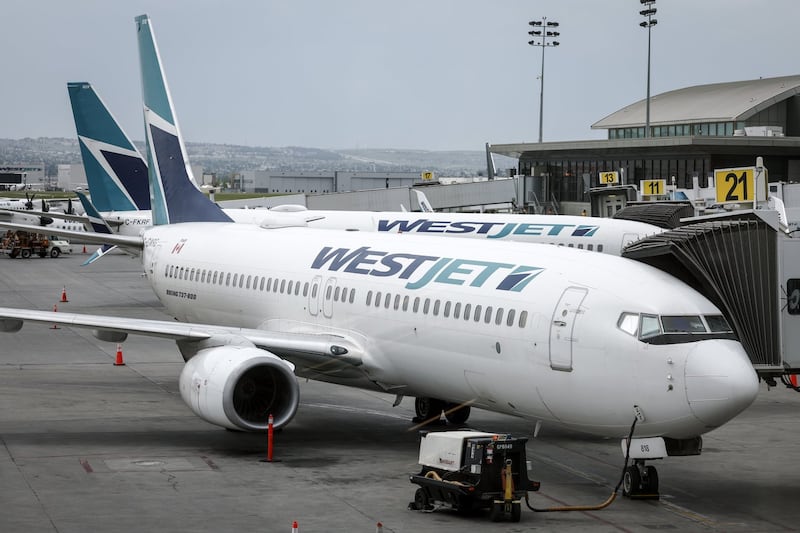
CALGARY -- Intense bargaining between WestJet and the union representing its flight attendants ratcheted up further on Thursday after CUPE issued a 72-hour strike notice, paving the runway for a possible airline shutdown during the busy summer travel season.
The Canadian Union of Public Employees cancelled a news conference in Calgary on Thursday morning, saying it wanted to focus on hammering out a deal.
The union representing 4,400 cabin crew at WestJet said the two sides remain far apart on key issues.
“We have been clear about what needs to change, and we have worked hard to reach a fair deal,” Alia Hussain, chair of the union’s WestJet contingent, said in a news release early Thursday.
“There’s still time to avoid a strike,” Hussain added. “We will continue to bargain around the clock until this is resolved.”
WestJet responded to the union’s strike notice by issuing a 72-hour lockout notice.
The carrier — the second-largest in Canada — said it is still negotiating to reach a deal.
“The decision to issue a lockout notice in response to the actions taken by the union was not one that was made lightly. We sincerely regret the inconvenience and uncertainty this continues to cause for our guests,” said CEO Alexis von Hoensbroech in a statement.
“We greatly value the work and contributions of our cabin crew, and it is our responsibility to ensure the integrity of our network and to minimize the risk of stranding our guests, crew and aircraft.”
While serving notice does not commit the union to a strike, job action could begin as soon as Sunday at 12:01 a.m. MT if the two sides don’t reach a deal.
Unless a tentative agreement is reached, some flights could start to be grounded by Friday.
At the Calgary International Airport, WestJet passengers held a medley of emotions about the impending strike.
Some were troubled about the threat of a walkout by workers of the Calgary-based airline. Others were indifferent and a small faction were unaware.
Marni Reid, from Medicine Hat, was leaving for Copenhagen with six other family members on a trip to visit family.
“I’m a little worried; I’m scared, actually,” she said at the airport Thursday morning.
The family is set to return on Aug. 13, which means they have nearly two weeks for the two sides to come to a resolution.
“We have a travel agent that is on standby, and if we have to, we’ll split up ... to get us home on different flights,” Reid said.
Richard and Janice Buchynski, from Prince Albert, Sask., were travelling to Whitehorse, also to see family, and are set to return home on a WestJet flight to Saskatoon on Tuesday.
“We’re not sure how we’re getting home,” said Richard Buchynski. “We’ll see how it pans out.”
“We might have to take a bus or whatever to get home,” Janice Buchynski said with a nervous laugh.
She added that WestJet sent the pair an email detailing how it would help find alternative travel if needed.
Federal Transport Minister Steven MacKinnon said Wednesday that “talks are progressing” and he remained hopeful a new collective agreement could be negotiated.
WestJet has been allowing passengers with flights scheduled between July 30 and Aug. 4 to make a one-time change or cancel it with no fee.
Travellers booked on the regional WestJet Encore service or code-share flights run by an airline partner such as Delta Air Lines will not be affected by a strike, the carrier said.
Should flight delays or cancellations occur, the airline said impacted guests will be refunded or reaccommodated “as applicable.”
The two sides this week also signed an agreement — shared with union members and obtained by The Canadian Press — that lays out how to ground planes and get cabin crew home in the event of a work stoppage.
Cabin crew working a flight when any job action begins would complete the trip to the destination. Those who can’t immediately return to their home city would receive hotel accommodation for up to a week or a plane ride back to another Canadian city “subject to seat availability.”
The union has said key issues include unpaid work for tasks such as ground duties. WestJet has said all duties are compensated through a “credit hour” system rather than an hourly rate.
The office of Patty Hajdu, minister of Jobs and Families, said in an emailed statement Thursday that “Canadians are experiencing uncertainty on many fronts, and they are counting on both parties to work together to reach a deal at the bargaining table.”
John Gradek, who teaches aviation management at McGill University, has said even a brief shutdown would cost the carrier millions of dollars during the height of summer travel.
The airline says it operates more than 600 flights per day, carrying legions of passengers — more than 70,000 on some days.
This report by The Canadian Press was first published July 30, 2026.
By Aaron Sousa in Edmonton, Christopher Reynolds in Montreal and Dayne Patterson in Calgary

