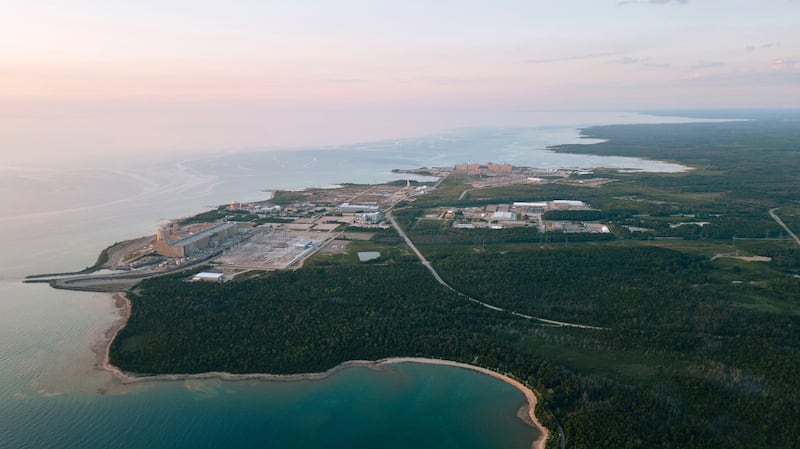
The Ontario government is moving ahead on a cost-sharing agreement worth up to $300 million to advance the construction of a new nuclear generating station at the Bruce Power site in Kincardine, Ont.
The deal between the Independent Electricity System Operator (IESO) – the Crown corporation responsible for operating Ontario’s electricity market – and Bruce Power would lay the groundwork for the construction of the new facility, a project known as Bruce C.
The government says the deal is a “major step” toward a project that will eventually make the Bruce site the largest nuclear generating facility in the world. It would also be Ontario’s first large-scale nuclear project in over 30 years.
The agreement would help fund a variety of work, such as pre-construction and site preparation planning, workforce planning and engagement with First Nations and the wider community.
The preparatory work, expected to be complete by 2030, would pave the way for the construction of the Bruce C facility, a proposed 4,800 megawatt (MW) nuclear generating station which the government says would provide enough electricity to power 4.8 million homes.
Details about the announcement were shared with CP24 beforehand.
Deal will create ‘tariff-proof’ jobs: Minister
Ontario Energy Minister Stephen Lecce formally announced the agreement at a news conference Thursday morning.
He said the project would create “tariff-proof” and “recession-proof” jobs over multiple generations.
“It is nuclear that stands alone, that has the capacity to fire up Ontario’s industrial base,” Lecce said.
Daniel Tisch, president and CEO of the Ontario Chamber of Commerce, also spoke at the announcement. He cited an economic impact report by his organization that estimated Bruce C could contribute $238 billion to Canada’s GDP through supply chains, construction, indirect jobs and other factors.
Lecce said the report includes the impact to other industries of having reliable energy with predictable costs.
“In the absence of having that power source, we wouldn’t be able to unlock hundreds of billions of dollars to our economy,” Lecce said. “Think about manufacturers. Think about connections. They want to expand. They need power.”
He noted nuclear power has one of the lower levelized costs of electricity, a key metric for comparing what different power types costs over the lifetime of a power plant.
He predicted the Bruce C project would create 18,900 net-new jobs per year.
Federal approvals still needed
Currently, Bruce Power operates two generating stations – Bruce A and B – with a total of eight reactors. The total number of new reactors for Bruce C has not yet been determined.
The government says it is “committed” to engaging with First Nations communities on the new facility.
The project still requires federal approvals to proceed. Work is currently underway on a federal Impact Assessment (IA), expected to be completed in 2028 and funded through a separate 2024 cost-sharing agreement between IESO and Bruce Power. The project also requires a site preparation licence from the federal Canadian Nuclear Safety Commission (CNSC).
Nuclear power currently provides about 50 per cent of Ontario’s electricity supply. The Ford government has doubled down on nuclear power as part of its long-term energy strategy for the province, extending the life of existing nuclear facilities in Pickering and Darlington.