Canada’s economy posted its strongest monthly expansion in a year, and economists warn the recovery remains heavily reliant on the energy sector.
Statistics Canada reported on Tuesday that real gross domestic product (GDP) expanded by 0.5 per cent in April, marking the strongest economic growth rate the country has seen since July 2025.
The stronger-than-expected reading was driven by broad-based gains across the economy, including a rebound in construction, increased public sector spending and improving activity in Canada’s housing market, Dominique Lapointe, director of macro strategy at Manulife Investment Management, told BNN Bloomberg.
The biggest contributor, however, was energy, he says.
“Energy contributed perhaps more than half of the 0.5 per cent monthly growth, whether it’s from conventional and nonconventional oil and gas extraction, pipeline transportation, but also refined petroleum product manufacturing. Those all went up,” says LaPointe.
Lapointe says a rise in energy demand is a continuation of a trend seen since the beginning of the year.
“We’ve seen more global demand for Canadian energy, and at the same time, the fact that the Trans Mountain pipeline is now in full capacity, really supports the growth of that sector,” says LaPointe.
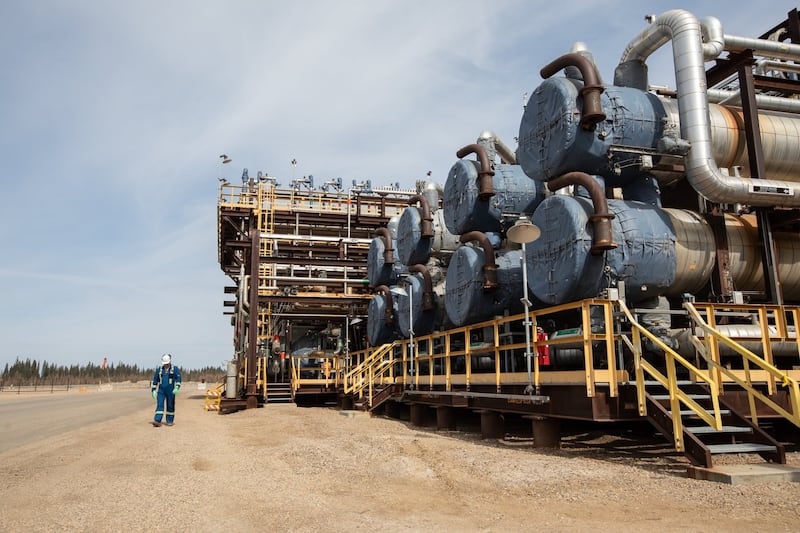
LaPointe says while Canadian energy will always be somewhat restrained by transportation capacity, the intent to produce more is evident in the prices. He highlights that Western Canadian Select, Canada’s primary benchmark for heavy crude oil, was trading around US$56 per barrel, more than 30 per cent higher than at the start of the year, even as global oil prices had declined since mid-May.
He added that because energy revenues are in U.S. dollars, a weaker Canadian dollar has also helped make production more lucrative.
“If they can get more products to market, they will,” he says.
Beyond energy, the GDP has shown strength in retail trade, manufacturing and transportation, Sébastien McMahon, chief economist at iA Financial Group, told BNN Bloomberg.
“This is pretty much the tide that is lifting our boats right now,” says McMahon.
Economists dismiss recession concerns
LaPointe pushes back against the idea that Canada is in a recession. He says earlier declines in GDP were largely the result of inventory adjustments rather than weakness across the economy.
“We’ve had nearly zero growth for the last five quarters, and that’s bad in itself,” he says.
“We were not labelling the weakness we saw as a recession, you look at other recessions, they were much, much deeper, but that being said, I don’t want to be too positive on the economy.”
Manufacturing remains the weak spot
While April’s gains were broad-based, LaPointe says manufacturing remains Canada’s biggest economic concern.
He says he does not expect a renewed Canada-U.S.-Mexico Agreement (CUSMA) to be reached anytime soon or expect the ongoing U.S. tariffs on steel, aluminum and copper to be removed this year.

“The big question is on manufacturing,” he says, noting many Canadian communities continue to rely on factory employment.
LaPointe says businesses appear to have already adjusted to the expectation of modestly higher tariffs, limiting the likelihood of another major shock if no agreement is reached immediately following the CUSMA review deadline.
- Key U.S. complaints against Canada ahead of trade review
- Canadian industries feeling ‘insecure’ ahead of expected CUSMA deadline extension
Growth increasingly depends on new export markets
McMahon says Canada’s next phase of growth will depend on expanding trade with the rest of the world, rather than just the U.S.
He says exports to non-U.S. markets have increased by nearly 50 per cent in value since 2024, reducing Canada’s dependence on its largest trading partner.
“The nation buildings projects; the terminals, the ports, the pipelines, that is part of the solution, but of course it’s going to be a slow unwinding story, but I think we’re on the right track, but again, we need to see businesses invest again, that’s going to be key,” says McMahon.
Rate hikes remain a 2027 story
McMahon says the Bank of Canada is in risk management mode, and does not need further interest rate hikes this year.
“At some point the markets were pricing in three hikes, which we thought was just bonkers, to be honest,” says McMahon.
“We would need to see an inflationary backdrop to build for the bank to want to have to hike,” he says, pointing to recent core inflation readings of 1.6 per cent, below the Bank of Canada’s two per cent target.
McMahon says the Bank of Canada is at the bottom of its neutral range and should remain there until the end of the year.
If the central bank moves, he says, it would likely be a hike, but “likely it’s a 2027 story.”

