Canadian provinces and territories need to maintain a “unified approach” if they want to secure a trade deal with the United States that benefits the entire country, says a former public policy adviser.
Their collective decision to keep American alcohol off store shelves also appears to be working, according to Diamond Isinger, former special adviser to former prime minister Justin Trudeau on Canada-U.S. relations.
“It’s clearly yielding results. It’s clearly being noticed by the president. It’s something very frustrating for him, and it’s having very real economic effects on American producers,” says Isinger.

Several provinces began removing American beer, wine and spirits from government-run liquor stores in retaliation for U.S. tariffs on Canadian goods last year.
On Monday, U.S. President Donald Trump signed an executive order imposing 50 per cent tariffs on certain Canadian exports, with the White House criticizing Canadian provinces for continuing to keep American beer, wine and spirits off their shelves.
The following day, nine premiers signed a domestic trade agreement that did not restore U.S. alcohol sales in Canada but rather agreed to dismantle internal provincial trade barriers, so provinces can sell to each other.
“Without us there’s no way they can survive,” Trump said from the Oval Office in response.
But Isinger says Trump’s comments suggest the provinces’ coordinated strategy is having an impact.
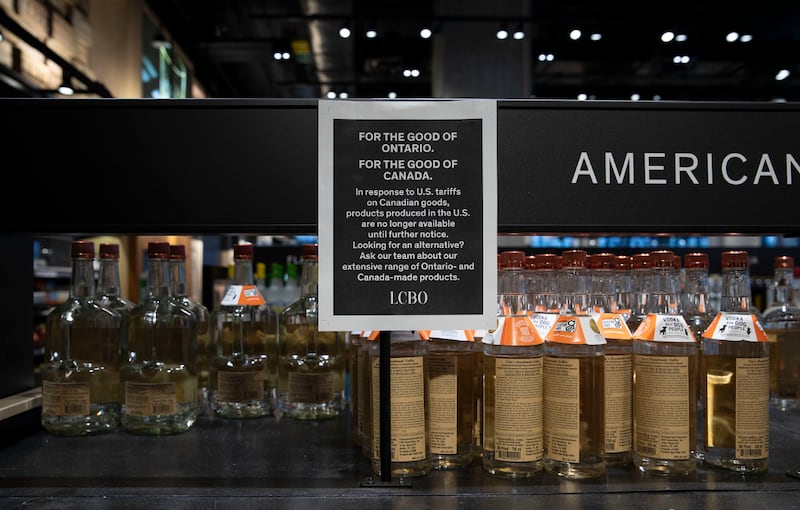
She says the alcohol restrictions should not be lifted until the latest U.S. trade actions, including the proposed 50 per cent tariffs, are resolved.
“We cannot continue to make significant concessions to the United States without seeing tangible results, actually mutually beneficial agreement going forward,” says Isinger.
“So I hope the provinces remain strong and are able to stay strong and see how that complements the federal strategy going forward.”
“Significant information’ still needed from provinces
Prime Minister Mark Carney met with Canada’s premiers in Charlottetown on Thursday for a First Ministers’ Meeting, where leaders discussed the impact of the latest U.S. tariff threat. The meeting, which had initially been expected to focus on housing and health care, shifted almost entirely to trade after Trump’s executive order targeting Canadian exports.
Carney offered few public details about the discussions, which Isinger says is likely intentional.
“There’s still significant information that needs to be gathered from industry in Canada,” she says.
“Those will inform what options need to be rolled out over the coming weeks, or if a resolution can be reached ahead of August 19.”
She says maintaining a Team Canada approach is essential, arguing Canada cannot sacrifice one province’s economy to benefit another.
“That’s ultimately the calculus that is among the most challenging for the government of Canada to contend with,” says Isinger.
Yukon Premier Currie Dixon echoed that message after the meeting in an interview with BNN Bloomberg, saying premiers are united behind Carney’s strategy.
“What I saw around the table today was that Canadian premiers are united behind the prime minister. We’ve got the prime minister’s back, and we’re hopeful that his strategy and his approach to dealing with Trump and the Americans will result in a positive outcome for Canada,” he says.
Dixon says Yukon intends to join the new direct-to-consumer alcohol agreement after passing the necessary legislation.
Using energy as leverage may be the right move
Isinger says Ontario Premier Doug Ford’s suggestion that Canada use its energy exports as leverage in the trade dispute may be worth considering because it is one of the few pressure points Canada has yet to use.
“It would manifest itself as significantly increased costs of living for Americans,” says Isinger, adding Trump deliberately exempted essential natural resources from the proposed 50 per cent tariffs.
She says there are several ways Canada could organize a potential response that does not necessarily need to match U.S. tariffs equally. It could be strategic.
She points to 2018, when Canada imposed retaliatory tariffs on specific U.S. products, including Pennsylvania ketchup and Florida orange juice, after the United States introduced tariffs on Canadian steel and aluminum.
Those products were chosen because they came from politically sensitive regions, increasing pressure on local businesses and workers to lobby their elected officials.
“It meant that those local effects were felt in a very real way, and that those businesses and workers and others were speaking up to their elected officials, who were then speaking to the president,” says Isinger.
Tariff threat presents two opportunities
Isinger says the ongoing tariff threat “is creating a tremendous amount of investment uncertainty of decision making,” where businesses “aren’t willing to make forward-looking decisions until they have clarity about what’s happening with the U.S.”
She says Canadian businesses may simply have to adapt to a new normal of constant uncertainty and unpredictable trade developments.
Still, she says the tariff threat provides an opportunity to Canada in two ways.
“One, it is a real threat. It is possible that 50 per cent comes into effect, but it’s also an opportunity for us to continue to get our own house in order here in Canada, control what we can control, and have meaningful conversations with the U.S. administration,” says Isinger.

