


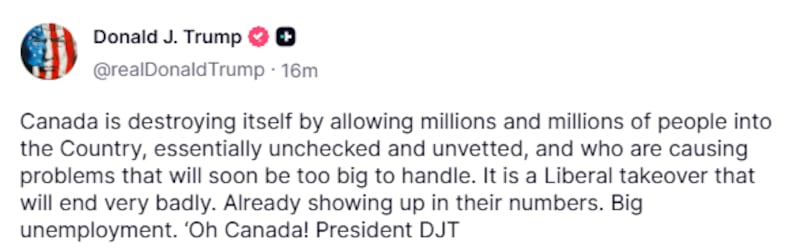
U.S. President Donald Trump says, “Canada is destroying itself by allowing millions and millions of people into the Country.”
He made the statement on his Truth Social platform Wednesday morning, accusing Canada of allowing people in who are “essentially unchecked and unvetted” and ”causing problems that will soon be too big to handle.”
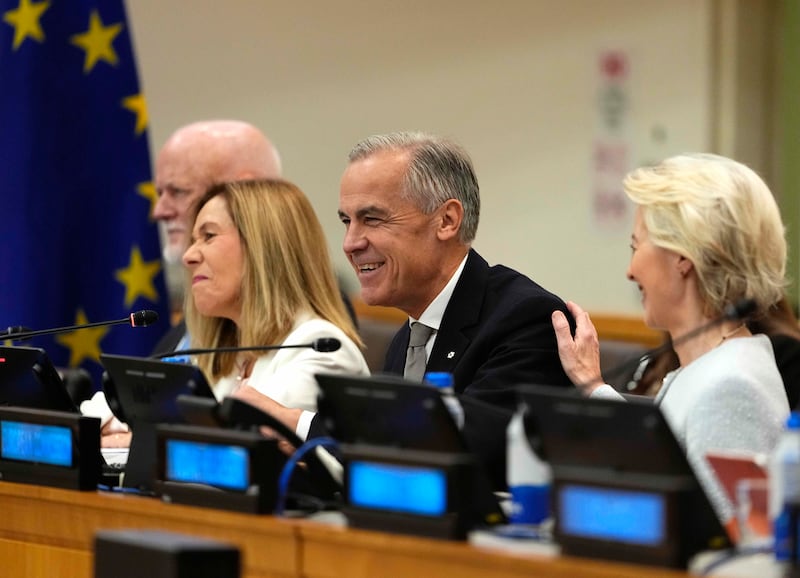
Meanwhile, Prime Minister Mark Carney spoke at a so-called “pledging event” for the OceanEye observation system, funded in large part by the European Union, in New York today.
Carney joined European Commission President Ursula von der Leyen at the event, a week after she said she’s interested in pursuing EU “associate member” status for Canada.
Key updates:
- Trump says Canada is ‘destroying itself’
- Canada investing millions in Ocean observation
- India’s Modi to visit Canada
Here’s what happened on Sept. 23, 2026:
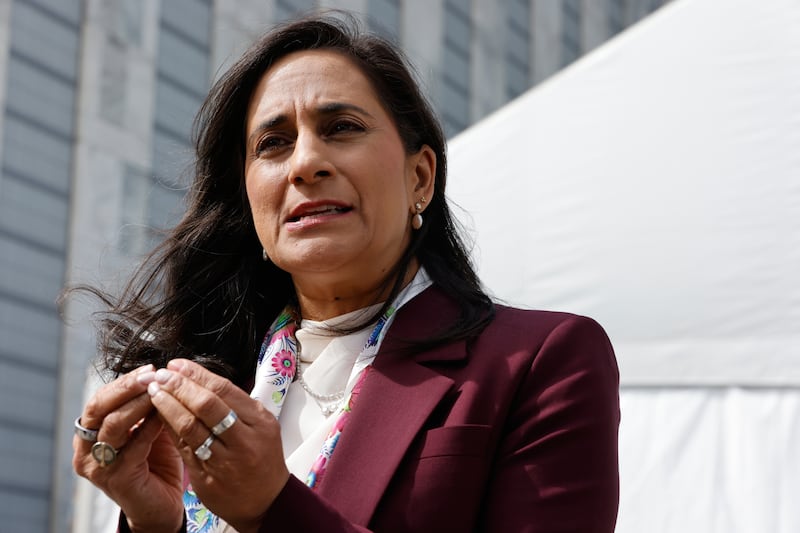
Anand responds to Trump
Asked to respond to Trump’s comments, Foreign Affairs Minister Anita Anand said that, while immigration overall has improved “Canadian prosperity,” the federal government reduced immigration intake in 2024.
“We are stabilizing immigration levels,” she said Wednesday, adding Ottawa moved to reduce levels to ensure accessibility to affordable housing and health care.
Canada plans to reduce temporary resident volumes to five per cent by the end of 2027.
Overall permanent resident admissions are projected to stabilize at 380,000 from 2026 to 2028, with a preference on offering status to migrants who are already in Canada with “needed skills and experience.”
Luca Caruso-Moro, CTVNews.ca journalist
No more Trump Ave.
A street in Canada’s capital bearing the name of the current U.S. president will be renamed.
Ottawa city council unanimously agreed to a motion to begin the process of renaming Trump Avenue, in Ottawa’s Central Park neighbourhood.
Trump Avenue is one of several streets in Central Park that references New York City. Other street names include Madison Park, Manhattan Crescent, Bloomingdale Street, and Staten Street.
At the time of the neighbourhood’s development, Trump was a famous real estate mogul, but his tumultuous time as president of the United States has led to renewed calls to take his name off street signs in the capital.
Ted Raymond, CTVNewsOttawa.ca journalist. Read the full story here.
Trump talks Canadian unemployment
In Trump’s post, he mentioned what he called Canada’s “big” unemployment rate.
“It is a Liberal takeover that will end up very badly,” he said. “Already showing up in their numbers. Big unemployment.”
Canada’s unemployment rate was 6.4 per cent in August, according to the most recent labour survey from Statistics Canada.
That’s more than two percentage points above the U.S. reported unemployment rate, which was 4.1 per cent in August. However, the two countries calculate unemployment differently. For example, Canada considers people who are not working because of family responsibilities as unemployed, but the U.S. does not.
A TD study released in the fall of 2025 predicted the unemployment rate would have been at least one point higher if population growth had not been slowed.
Unemployment is impacted by a number of factors, not limited to immigration. For example, Statistics Canada noted accelerated employment losses in trade-dependent industries following Trump’s imposition of tariffs on Canadian goods.
Luca Caruso-Moro, CTVNews.ca journalist

Data contradict Trump immigration claims
As U.S. President Donald Trump says Canada is “destroying itself” with its immigration policies, new data from Statistics Canada show the number of newcomers is going down.
According to Statistics Canada, Canada’s population rose slightly by 0.2 per cent in the second quarter, while immigration is down 4.2 per cent year-over-year, and the number of non-permanent residents is down 0.7 per cent.
The Canadian government under former prime minister Justin Trudeau pledged to cut its immigration targets following years of criticism that they were putting too much pressure on the housing market and other sectors.
In Prime Minister Mark Carney’s first budget in late 2025, the Liberals set new targets, promising to “responsibly manage immigration to alleviate pressures on housing demand.”
Immigration levels in Canada reached a record high in 2024. According to the federal government, 483,640 immigrants were admitted as permanent residents that year, which was in line with targets set out in the Government of Canada’s Immigration Levels Plan at the time. In 2025, that number dropped to about 393,500 new permanent residents.
Spencer Van Dyk, CTV News writer & producer
Carney talks bilateral collaboration
Carney, who is co-hosting the OceanEye event, says the meeting is in the same spirit as his trip to Strasbourg last week, where talk of Canada’s associate EU membership made headlines worldwide.
Today, he said, is all about what “nations coming together” can accomplish. He did not mention the United States in his opening remarks.
He said Canada is committing $82 million to the ocean observation program, which he characterized as an imperative step for the country with the world’s longest coastline.
Luca Caruso-Moro, CTVNews.ca journalist
Canada to protect more lands and waters
Carney said Canada plans to send autonomous underwater gliders on months-long assignments to monitor activity under the Arctic ice.
“We can’t protect what we can’t see,” he said, adding Ottawa plans to expand protected lands and waters to two-million-square kilometres by the end of the decade.
Luca Caruso-Moro, CTVNews.ca journalist
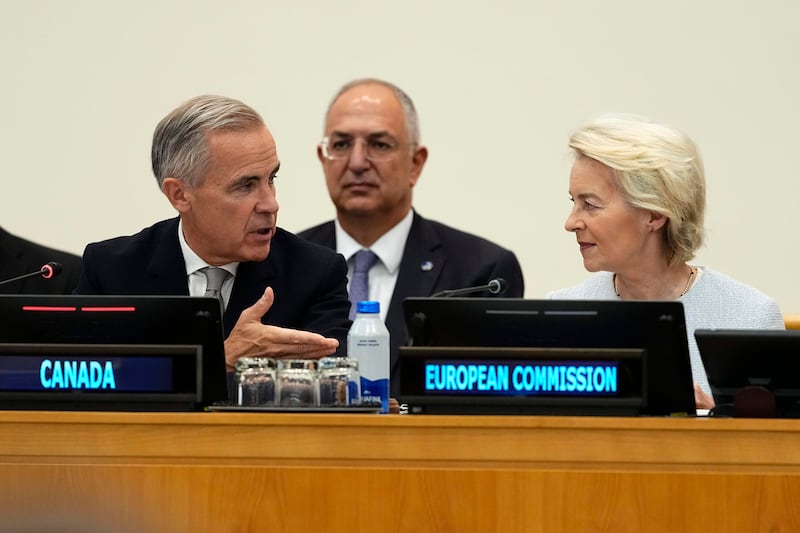
Carney to appear with EU leader
Carney will speak at the OceanEye International Alliance event at 10 a.m. EDT. The OceanEye initiative aims to build capacity for marine observance, which the European Commission says is associated with a market worth up to C$32 billion.
“This serves a much larger business ecosystem worth EUR 40 to 90 billion, in which the United States holds the largest share,” reads a statement from the commission published earlier this year.
Luca Caruso-Moro, CTVNews.ca journalist. Read the full story here.
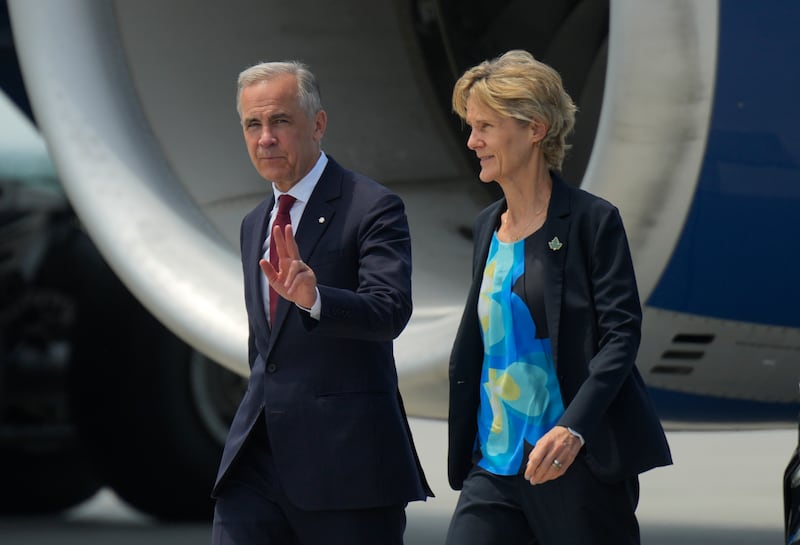
Diana Fox Carney is Canada’s Ocean Envoy
Diana Fox Carney, who’s married to Mark Carney, is Canada’s Ocean Envoy. She was named to the unpaid position in mid-September.
“In this role, Mme. Fox Carney will advance Canada’s leadership by connecting ocean conservation, climate action, Indigenous leadership, economic resilience and maritime security,” reads a release announcing her appointment.
Fox Carney, an economist and sustainability advisor, holds master’s degrees in agricultural economics from the University of Oxford and in international relations from the University of Pennsylvania.
Luca Caruso-Moro, CTVNews.ca journalist
Here’s what happened on Sept. 22, 2026:
India’s Modi to visit Canada: Carney
Carney confirmed on Tuesday that Indian Prime Minister Narendra Modi will be visiting Canada in December.
The news was first reported by the Globe and Mail on Tuesday, citing India’s High Commissioner to Canada, who says Modi will be visiting to sign a trade deal between the two countries.
“We are making good progress in our trade negotiations with India,” Carney said, before confirming Modi’s mid-December visit to Canada.
“It is an exceptionally important relationship on many, many levels.”
Modi’s last trip to Canada was in June 2025, when he attended the G7 Summit in Kananaskis, Alta.
The visit raised eyebrows at the time because of the previously strained relationship between Canada and India.
The two countries had been at odds since 2023, when the federal government first levelled allegations of both foreign interference and transnational repression, including crimes such as murder and extortion.
At the time, talks toward a free-trade agreement — which had been underway for years — were indefinitely put on pause, and not picked up again until Carney became prime minister.
Spencer Van Dyk, CTV News writer & producer
Carney reacts to Trump’s Belarus potash deal
Carney touched on Canada’s potash industry, after Trump revealed on Monday that the U.S. plans to buy cheaper product from Belarus.
“My message to the Canadian potash industry is one of admiration,” Carney said to reporters at the UN. “Canada supplies 40 per cent of the world’s potash. It is an incredible strength of our economy.”
Carney affirmed that Canadian potash would continue to be in demand around the world due to Canada being a reliable, cost-competitive supplier.
The prime minister also said Canada will continue to be the largest supplier of potash to the U.S. and expressed that now is an opportunity for Canada and its neighbours to co-operate and “become fertilizer independent.”
“So not just potash, but across all ammonia and other fertilizers, that would be good for Canadian farmers,” he said.
“It’d be great for American farmers, and it’s an opportunity we’re prepared to explore.”
Kayla Thompson, CTVNews.ca journalist
U.S. to continue buying Canadian potash: Trump
Trump says his country will continue buying Canadian potash after all.
Trump made the comments to reporters during a bilateral meeting at the United Nations General Assembly with Ukrainian President Volodymyr Zelenskyy.
“Belarus has a lot of potash, and our farmers need good prices, and we want to get a lower price,” Trump told reporters Tuesday when asked about the proposed deal.
“We’ll continue to go with Canada, but Belarus would like to sell it for a much lower price.”
The Canadian Press. Read the full article here.

