There were more energy announcements in Calgary Saturday morning as federal energy minister Tim Hodgson announced more than $26 million to fund 17 clean energy projects across Alberta and Saskatchewan.
The funding will be used to “accelerate the deployment of clean technology, modernize energy systems and infrastructure, reduce emissions and build the regulatory, industrial and workforce capacity needed for Canada’s long-term economic growth and energy security,” Natural Resources Canada said in a media release.
The announcement, the federal government’s third energy blockbuster in two days, is part of a co-ordinated strategy, Hodgson said.
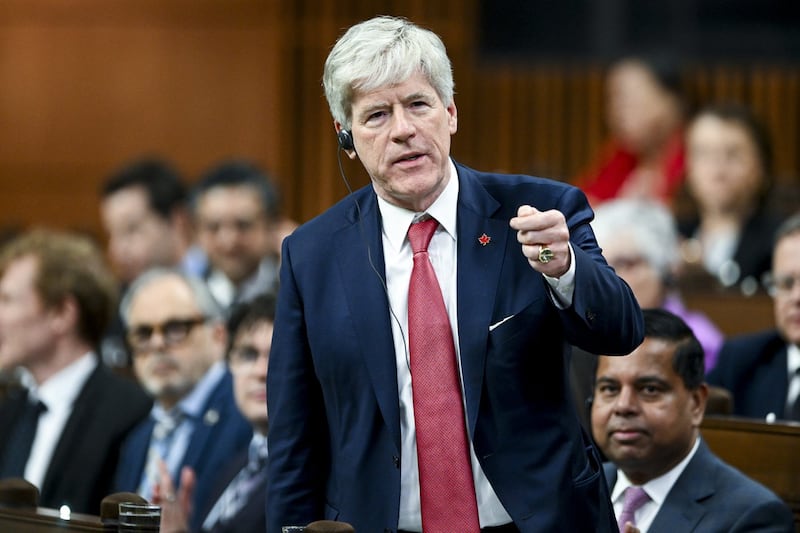
“With this week’s announcement of the referral of the new West Coast Pipeline to the Major Projects Office, and the advancement of Pathways -- the world’s largest CCUS (Carbon Capture Utilization and Storage) project -- we are truly making good on our promise to Canadians to not only be an energy superpower but to do it in a pragmatic, sustainable way, in partnership with provinces and Indigenous peoples, and in a way that it makes it clear to Alberta -- and every Canadian province -- that cooperative federalism works in this country,” Hodgson said.
Projects include:
- $14.9 million for 10 projects that will advance energy storage, solar and wind energy development, interprovincial electricity transmission planning, Indigenous-led clean energy projects and workforce development;
- $5.9 million for two facilities that will convert waste biomass to renewable natural gas with carbon capture;
- $3.5 million for two projects that will reduce methane emissions and advance low-emission cement alternatives that store carbon; and
- $2.3 million for three projects that will support higher energy-efficiency building codes.
“We need to build to be a clean and conventional energy superpower. Without a smarter, more connected grid, our energy future will be at a standstill at a time where it has never been costlier not to act,” Hodgson said.
Hodgson said the federal government remains committed to its 2050 net-zero emissions goal, despite criticism from some over Friday’s announcements of a new pipeline project and an energy centre.
“Today is about showing we need to be a clean and conventional energy superpower,” Hodgson said. “We’re advancing things on the conventional side, and we’re advancing things on the clean side.
He said what’s changed in the year since Mark Carney became prime minister is that Ottawa and Alberta are getting on the same page in terms of energy development.
“The pipeline is part of a bigger deal,” he said. “It’s a deal that allows provinces to share renewable energy. It’s a deal that allows us to cut peak generating requirements as we share across borders.
“It’s a deal about how we bring new nuclear to this province, new zero-emitting nuclear power to the province of Alberta, it’s how we meet the challenge of AI in an environmentally responsible way.
“So when people try to make this about one project, they’re missing the point,” he added. “The point was a year ago, the federal government and the Alberta government were not working towards the same objective (whereas) today, we are working towards the same objective to be clean and conventional energy superpowers.
“This (funding announcement) is part of the bigger deal that gets us there.”
Most projects in Saturday’s announcement are being funded by the feds’ $4.5 billion Smart Renewables and Electrification Pathways Program, which is designed to support grid modernization, energy storage and renewable energy technologies across Canada.
Jody Linklater of Clean Communities Corporation praised the initiative.
“This project shows that Indigenous ownership can play a valuable and complementary role in building reliable, resilient clean energy systems,” Linklater said.
“Today’s announcement is a meaningful step forward, and we’re excited about the opportunity to build on success together,” Linklater added. “We see it as a foundation for many more projects that will continue to grow Indigenous capacity and leadership in Canada’s clean energy future work that we hope will help ensure the next generation inherits not only cleaner energy, but greater opportunity to shape their own futures.”
‘Conservatives support real energy projects’
Conservative Shadow Minister for Natural Resources Carol Ansley also weighed in on the announcement, sending CTV News the following statement:
“Conservatives support real energy projects that create jobs and strengthens the grid to provide affordable energy for Canadians. However, this announcement doesn’t accomplish that. It is another Liberal photo op that gives the illusion of support, while only providing small funding mostly for studies and small scale projects.
“The Liberals are still keeping the same anti-development laws, taxes and red tape that block major energy projects from getting built and prevent Western Canada from prospering further.
“Conservatives believe in announcements that lead to real results, If Mark Carney is serious about energy security, he should get out of the way and let Canadian workers build.”
With files from CTV News’ Tommy Osborne

