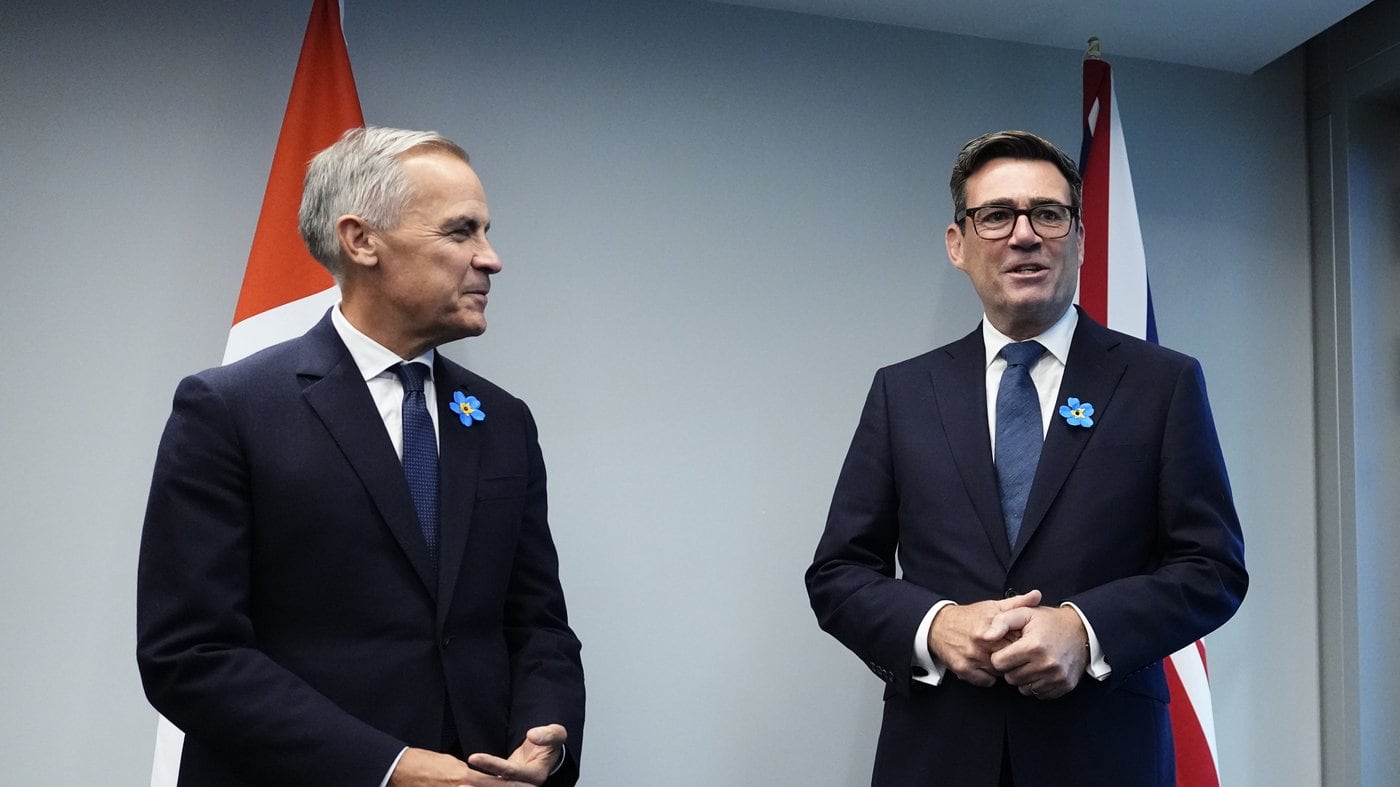
LIVERPOOL — Prime Minister Mark Carney met for the first time face-to-face with British Prime Minister Andy Burnham on Wednesday, bonding over common values, a love of sports and a shared loss of their fathers to Alzheimer’s disease.
The two leaders watched the Wolverhampton Wanderers play the Everton Football Club — Burnham’s favourite team — in a League Cup game in Liverpool, England.
When they had their first call in July, a readout from 10 Downing said Burnham told Carney he “hoped to be able to roll out the blue carpet” for him in the future — a reference to Everton’s colours and the invitation to the game.
The two men sported the blue and yellow brooch of the Alzheimer Society on Wednesday, in recognition of Burham’s father who just recently died of the disease. In his own remarks, Carney noted that he too had lost his father to Alzheimer’s.
Burnham called Carney a “great progressive leader” and spoke about the shared values between U.K. and Canada, and where the two have a shared opportunity on defence co-operation, trade and AI.
“There’s been positive developments in that direction recently between the U.K. and Canada,” said Burnham, who took office after Keir Starmer resigned over the summer. “And it’s just so good for me to think that I will have somebody to talk to and commiserate about Everton at a G7 meeting.”
Canada has formally applied to join the U.K.-led Joint Expeditionary Force as a full-time member, a bid that London is supporting, Prime Minister Mark Carney’s office said in a media statement Wednesday.
The joint force is a military coalition made up of 10 allied countries focused on NATO’s northern flank. It was assembled in 2014 to create a rapid-response force.
Canada’s military has worked with the force in multinational drills but has not been a permanent member of the group.
In their official meeting, the two leaders talked about defence, trade and the development of artificial intelligence, according to a readout from the Prime Minister’s Office in Ottawa.
It did not say whether the two leaders discussed U.S. President Donald Trump. Burnham is expected to meet Trump for the first time next week in New York.
Carney’s PMO noted that the two countries are working on a “new permanent arrangement” to modernize British Army Training Unit Suffield.
CFB Suffield’s 2,700-kilometre square training area in Alberta is being used by the British military for exercises and the testing of drones and other equipment.
London plans to spend some $18.7 million on British Army Training Unit Suffield through to 2031.
Canadian officials said London and Ottawa are also in active talks on merging their proposed defence financing initiatives to amplify their effects.
A senior Canadian government official who briefed reporters on background said Ottawa is very confident they’ll reach an agreement on bringing the two proposals together to form a joint institution.
Carney has championed the creation of a global Defence, Security and Resilience Bank to supply allies with low-cost borrowing for defence.
He’s enlisted support for that venture from eight countries, including Latvia, Luxembourg, Greece, Belgium and Ukraine. But no G7 country other than Canada has joined.
The United Kingdom’s separate effort, called the Multilateral Defence Mechanism, is designed as a financing vehicle for joint purchases of military equipment and has won support from the Netherlands, Finland and Poland.
British media first reported this week that Burnham’s finance minister, John Healey, is considering joining the Defence, Security and Resilience Bank.
Canada and the U.K. issued a joint statement at the annual NATO summit in Ankara, Turkey, this summer on how the two financial institutions could work together.
The statement said the two countries want to ensure their “respective initiatives develop in a coherent and mutually supportive way” and will “seek opportunities to co-operate closely and ensure complementarity.”
Money put into the defence bank counts toward the NATO target of having alliance members spend the equivalent of five per cent of their GDP on defence by 2035.
The head of Canada’s Business Development Bank, Isabelle Hudon, is working as the lead negotiator for the defence bank.
The U.K. is allocating $749 million toward the Multilateral Defence Mechanism and aims to stand it up in 2027.
Nick Murray, The Canadian Press
With files from Kyle Duggan in Ottawa
This report by The Canadian Press was first published Sept. 16, 2026.

