


SHENZHEN -- Prime Minister Mark Carney says Canadians should learn from China’s breakneck economic growth, even as he insists Ottawa maintains guardrails on expanding trade with Beijing to limit interference and U.S. blowback.
“We try to be clear with them. There are opportunities to unleash investment, and there are not in other parts of our economy,” Carney said in French at a news conference in Shenzhen, China on Wednesday.
Carney, who is attending the Asia-Pacific Economic Co-operation summit, also said the development of the city of Shenzhen — from a fishing village to a high-tech mega city — shows what can be achieved by cutting red tape.
“This city won investment with faster approvals, lower taxes and simpler rules for trade,” he said. “The choices that built this city can lift this whole region.”
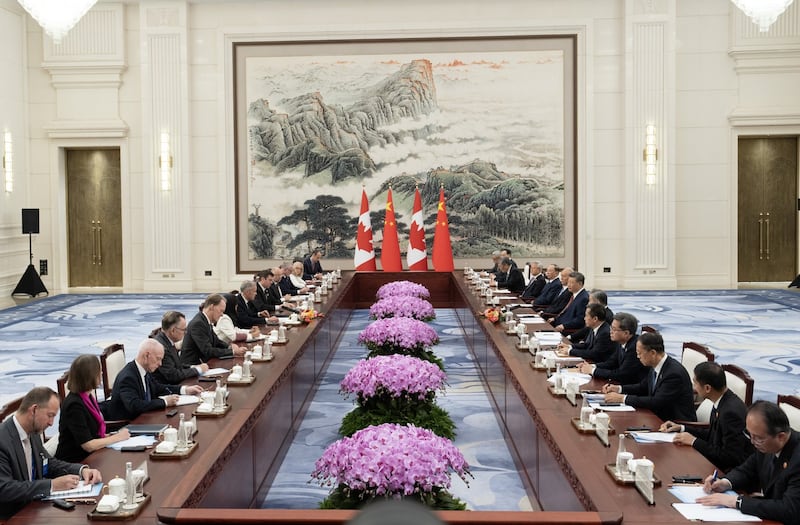
The prime minister’s visit started with an announcement that Canada would drop certain restrictions on imports of Chinese steel and aluminum in exchange for more market access for Canadian pork and other agricultural products.
The announcement also included news of a partnership on artificial intelligence — even though Carney previously said AI was among three sectors off-limits to Chinese investment in Canada, along with critical minerals and defence industries.
Carney said discussions with China have focused more on how to guard against economic and biosecurity risks.
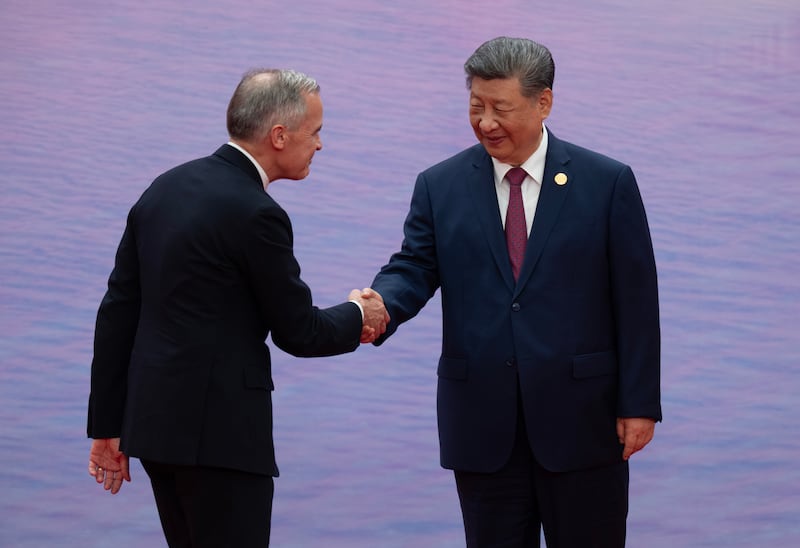
“The absence of any global governance around AI is an enormous risk,” Carney said. “I took the opportunity in the discussions with President Xi yesterday to share our views on a model for how this governance can be developed.”
Carney said Canada would shape its trade based on shared interests, citing the example of the European Union having press freedoms other countries and regions lack.
“The calibration depends on the values that we share with countries,” he said in French.
He said more market access to China benefits various sectors in Canada, such as fishing and farming, “but relative to many other countries, our trade with China is quite modest and the breadth of it is quite modest.”
Carney said his government is pursuing a “gradual opening” of its relationship with China after the diplomatic crisis of 2018 and reports that Beijing has engaged in political interference in Canada — reports which Beijing has denied.
“We’ve pursued a stabilization of the relationship first and a gradual opening of the relationship,” the prime minister said.
Carney’s recent agreements with China on trade have infuriated some of the people close to U.S. President Donald Trump.
Peter Navarro, the president’s trade adviser, has said it was “offensive in the extreme” for Carney to be “threatening to play China off the U.S.”
The prime minister said Canadian trade with China does not involve cutting-edge technology, as does American trade with Beijing.
Earlier Wednesday, Carney said Ottawa was trying to expedite major projects while working with countries such as China to limit its dependence on countries like the United States.
“I’ll be clear, these partnerships remain vital, but Canada is also a Pacific nation,” he told a gathering of CEOs at the APEC summit.
“The next chapter of Canada’s transformation will be written with partners in this region.”
The prime minister’s remarks came months after he publicly pursued closer ties with Europe. In June, he said a “new world order” would be built from Europe and Canada was seeking some sort of “associate membership” in the European Union.
Speaking on the sidelines of the CEO summit, analysts said Carney should seek out different trading relationships around the world based on the strengths of each continent.
“When it comes to Europe (it’s) defence, AI,” said Goldy Hyder, CEO of the Business Council of Canada.
“Asia in particular needs our energy, needs our food. And so the opportunities to do both are very much available for Canada, and that’s where growth is going to come from.”
Jeff Nankivell, head of the Asia Pacific Foundation of Canada, said it’s encouraging that Carney chose to spend the week at summits in China, Cambodia and the Philippines.
“It’s been very consequential,” he said, adding it’s not clear whether Canadians are ready to take up commercial opportunities in the region.
“Canadians are capable of being fast. We’re also capable, as we’ve seen, of getting in our own way.”
The prime minister told reporters that he has had “open, frank conversations” with Xi on matters that Carney has chosen not to make a focus of his public comments.
“Issues of human rights, issues of foreign interference, issues of transnational crime, narcotics trade — we raise them with our counterparts, including part of my discussions with President Xi,” he said.
This report by The Canadian Press was first published Nov. 17, 2026.
Dylan Robertson, The Canadian Press

