
Average rent prices in Oshawa, Ont., have decreased by nearly 11 per cent over the last year and a new report suggests that the trade war with the U.S. might be behind the fall.
Rentals.ca and Urbanation published their findings on Tuesday, revealing average asking rents across the country dropped by 4.8 per cent over the past year. The weight of tariffs has not yet slammed its hammer down on rent prices, according to analysts, as the effects are still trickling down on the costs of construction and labour.
But the report suggests that some communities most impacted by the tariffs are already seeing more substantial downward pressure on rents.
A cross-country look
Windsor, Hamilton, Kitchener-Cambridge-Waterloo and Brantford have higher exposure through the auto and steel sectors, according to the Canadian Chamber of Commerce. Saguenay and Trois-Rivieres are hit hard through aluminum, while Prince George, Nanaimo and Kamloops feel the impacts through lumber.
Calgary, which is ranked the highest on the tariff exposure index, sees it through its employment and business revenue because of their energy exports.
Across the provinces, Ontario and Quebec are heavily exposed through their manufacturing sectors, representing more than 10 per cent employment within their jurisdictions. In Alberta’s manufacturing, construction and resource sectors, 21.4 per cent of jobs are exposed to tariffs.
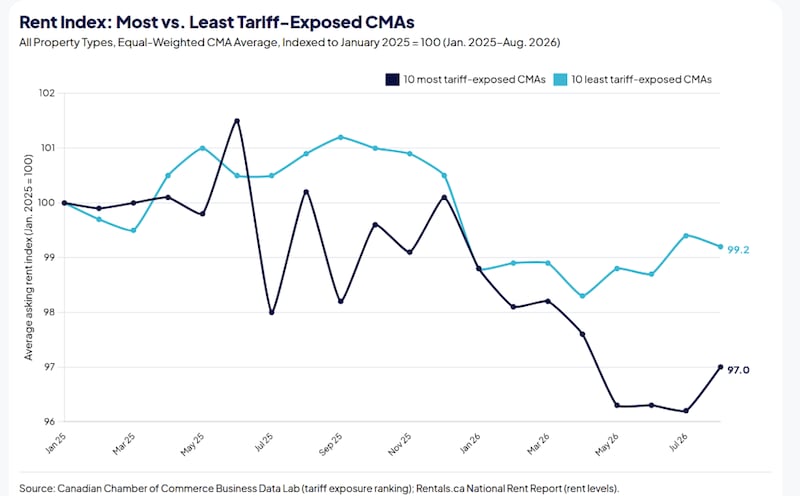
“While there has already been an observable correlation between rents and tariff exposure, with rents in the 10 most tariff-exposed CMAs falling faster than the 10 least-exposed, as of August, 2026, local market effects have remained the dominant factor,” the report reads.
Most and least exposed cities
Using data from the Canadian Chamber of Commerce, the analysis points to Calgary, Windsor, Kitchener-Cambridge-Waterloo, Brantford, Guelph, Hamilton, Trois-Rivieres, Lethbridge, Thunder Bay and Oshawa as the most tariff-exposed cities.
Rent in Oshawa has dropped by 10.8 per cent on average over the past year, but in Windsor, rent has only dropped by 2.4 per cent, due to its thinner rental supply.
Meanwhile, the least-exposed cities include Vancouver, St. John’s, Saskatoon, Halifax, Victoria, Regina, Winnipeg, Nanaimo, Kamloops, and Greater Sudbury.
Impact on supply and demand
Steel has been slapped with a punishing 50 per cent tariff by the United States, with Canada retaliating with its own counter-tariff of the same cost. The analysis points to Statistics Canada’s Building Construction Price Index, revealing the costs to fabricate metal have gone up 2.1 per cent quarter-over-quarter. For structural steel, prices have risen by 1.8 per cent over the quarter and 7.2 per cent since the first quarter of 2025.
Toronto and Vancouver will feel these impacts the most, the report notes, because of the dominance of highrises in these cities. Though condo starts have fallen, construction of these buildings relies on materials like steel and rebar, and their costs have been heavily inflated by the levies.
“With little to no condo construction to fall back on, Toronto and Vancouver are doubly exposed to potential price shocks on the supply side,” the report reads.
Purpose-built rentals have slowed down since their peak in 2021, as the analysis says fewer people are buying into the condo market (or the real estate market in general). Developers are facing challenges from falling rents, the report says, and with the added cost pressures of tariffs, projects could be shelved or cancelled.
The uncertainty of the ongoing trade war is pushing renters to stay where they are. Tariffs are thwarting the job market with highly exposed industries forced to implement cost-cutting measures like job cuts, hiring freezes, or fewer work hours. The analysis says this pushes property owners to offer lower rents or more concessions on new leases.
The effects of the tariffs implemented in August and September have not yet been felt, but the report says the previous rounds of tariffs have already left their mark.
Statistic Canada says 27,200 manufacturing jobs were lost in Ontario alone, with primary metals manufacturing in the province down by 18.4 per cent in a single year. Across Canada, there were 40,600 fewer manufacturing jobs in 2025 because of tariffs on exports across the border.

