One app tells you a bottle of Heinz tomato ketchup is prepared in Canada, another deems it partially Canadian, while a third calls it “not Canadian-owned.”
For consumers scouring the grocery store for Canadian-made food items after the latest eruption of U.S. tariffs, it can be difficult to discern which products are truly Canadian and which aren’t.
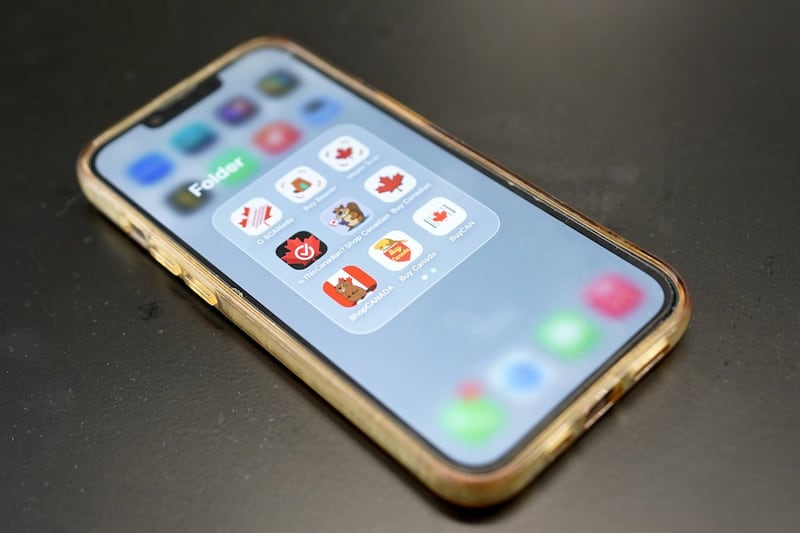
Multiple apps sprang up promising to help shoppers buy Canadian-made products after trade tensions with the United States broke out last year.
Users typically scan an item’s bar code or logo, which then produces results on how Canadian the item is. But each app has its own methodology, making apples-to-apples comparison difficult, and the level of detail varies.
Some apps call a product partly Canadian if its manufacturing plant is in the country, but the parent company is not. Others score items depending on where it was produced, where the ingredients came from and where the money ends up.
The result is a confusing array of apps for shoppers to choose from, and questions about which one is most accurate.
But experts say rather than finding one definitive answer, grocery shoppers likely need to weigh multiple factors for themselves.
“There’s a million different ways for someone to decide if something is Canadian or not,” said Bonnie Simpson, a consumer behaviour researcher and professor at Western University.
Pick one and learn
Uniformity is also impossible because app makers use different decision-making criteria.
Instead of trying to compare multiple apps, Simpson suggested picking one and learning about how it arrives at its results: find out who made it, what their methodology was and whether you can trust that.
For example, the scanner app Buy Beaver, made by Montreal-based tech entrepreneurs Alexandre Hamila, Christopher Dip and Arnaud Maheu, rates products on a scale of zero to 100 based on manufacturing location, where the parent company is headquartered and the source of ingredients.
Tests by The Canadian Press found it gave a Heinz tomato ketchup bottle a score of 70 out of 100. It correctly identified its manufacturing location in Quebec, ingredients mostly sourced domestically and said its parent company Kraft Heinz Co. is an American multinational.
Another app, O SCANada, identified the ketchup bottle as “not Canadian-owned,” based on its U.S. parent. It also offered information on manufacturing, ingredients and employee location.
The app, made by mother-son duo Cathy and Ryan Checora, puts the emphasis on a company’s ownership rather than how local a product is.
“Our goal is instead to provide the underlying information and allow consumers to decide for themselves what aspects of buying Canadian are most important to them,” Cathy Checora said in an emailed response.
Meanwhile, Maple Scan labelled the ketchup as “prepared in Canada,” which the Canadian Food Inspection Agency defines as food entirely prepared domestically.
The Canadian Press reviewed more than a dozen apps using a bottle of Billy Bee honey, then narrowed the field to three: Buy Beaver, O SCANada and Maple Scan.
The number of downloads and reviews each app had was factored in as an indicator of popularity.
What is ‘Canadian’?
Most apps are using artificial intelligence to sift through information online and curate results.
When there are different paths to deciding what’s Canadian, it can be confusing for some users testing multiple apps to know what’s more reliable.
Michael Mulvey, marketing professor at the University of Ottawa, said people need to have a good sense of their goals and what the apps can do for them before using them.
Apps are “trying to define what is Canadian, and there might be more than one way of defining that,” he said.
For instance, people who want to support Canadian workers would want to make sure the item was manufactured domestically, supporting the local agricultural or even the steel sector, which provides the metal for canned foods.
If the focus is on money staying within Canada, it’s vital to find out who owns the company, who the shareholders are and if your money is simply going to be transferred across borders, Mulvey said.
Buy Beaver identified a bag of Miss Vickie’s chips as 70 per cent Canadian: They’re owned by Frito-Lay and ultimately PepsiCo Inc., while the chips are produced in Canada with mostly domestic ingredients.
Maple Scan classified it as “made in Canada,” but pointed to its U.S.-based owner.
Some apps label products “made in Canada” or “product of Canada,” which sound similar but indicate different levels of domestic production.
Simpson said consumers who care where their products come from should know the difference.
Don’t aim for perfection
The Canadian Food Inspection Agency labels an item “product of Canada” when nearly all of the processing and labour used to make the product is Canadian. An item gets labelled “made in Canada” when the last substantial transformation of the item occurred in Canada.
Mulvey said if he were to pick an app, it would be one with a strong dataset available to examine.
Still, it’s sometimes impossible to get to the bottom of a product’s roots given the complexity of the food supply chain and the fact that Canada doesn’t produce a lot of what’s available at grocery stores, Simpson said.
Simpson said it’s important to recognize that there will be errors, as long as there are different criteria, and so it’s important to remember your goals as a shopper.
“Perfection is not an achievable goal for any Canadian consumer,” she said. “There’s simply too little information available, too much time to get the information and too many restrictions on accessibility of the products.
“The goal is really just to try to be better, and I think the apps are really positive tools to put that possibility in people’s hands.”
This report by The Canadian Press was first published Sept. 21, 2026.
Ritika Dubey, The Canadian Press

