Desjardins Group has completed its $1.67-billion acquisition of Guardian Capital, positioning the combined business to expand in asset management while navigating a volatile economic backdrop.
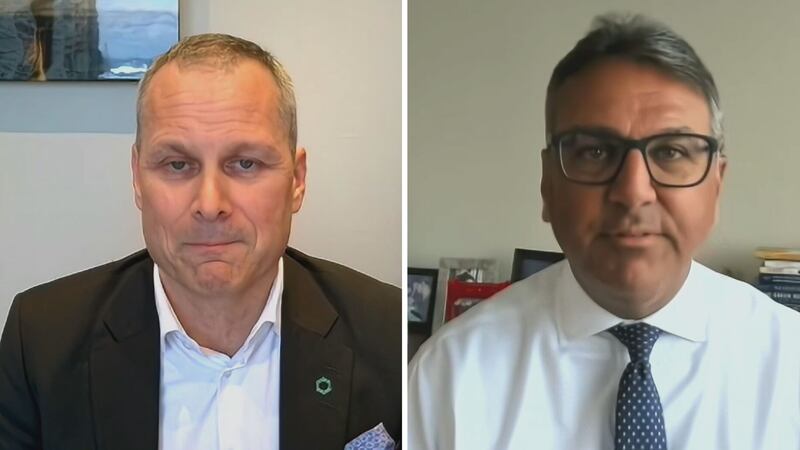
BNN Bloomberg spoke with Denis Dubois, president and CEO of Desjardins Group, and George Mavroudis, president and CEO of Guardian Capital and Desjardins Global Asset Management, about integration plans, client concerns and consolidation trends in the financial sector.
Key Takeaways
- Executives say the acquisition strengthens scale and global reach in asset management during a volatile market environment.
- Investors are being advised to stay focused on long-term strategies despite geopolitical tensions and market swings.
- Economic pressures, including tariffs, inflation and labour challenges, are weighing on business clients.
- Smaller asset managers face growing pressure to reinvest, driving expectations for further industry consolidation.
- Rising credit loss provisions reflect cumulative economic stress, though growth in lending remains a contributing factor.
Read the full transcript below:
MERELLA: A Desjardins Group affiliate, Desjardins Global Asset Management, has completed its $1.67-billion acquisition of Guardian Capital, announced last August. For more on their plans and the current investment environment, let’s go to Denis Dubois, president and CEO of Desjardins Group, and George Mavroudis, president and CEO of Guardian Capital. They join us now to talk some more. Denis, let me start with you, if you don’t mind. It’s a volatile time to do or finish an acquisition. How are you going to approach investing right now?
DENIS: So I think this is an exciting time for a transaction, as we are creating a leading Canadian asset manager with global presence. We’ve been working on this for a period of time, and bringing the two organizations together will provide increased capacity in order to better service our clients. And so I think this is positive news for Desjardins, but also for Canada today.
MERELLA: Okay, George, let me ask you, what are the key concerns you’re hearing from consumers or customers right now, clients right now, given everything that’s going on in the Middle East in the last three weeks?
GEORGE: Well, geopolitical issues are always of concern in the near term. But I think as investors, we’re always focused on the long-term principles, the long-term process that we have. And, you know, holding our clients’ hands through those short-term crises are very important, so they stay the course. And I think over the long term, you know, basic fundamental economics tend to play out as they should, and just staying invested is an important aspect for our investors to always remember.
MERELLA: Is that enough to calm people’s nerves when you tell them, you got to look at the long picture?
GEORGE: You know, it’s increasingly harder, it seems like, because I think newscasts like yourself and others are always tied to the markets on a seemingly by the minute basis. But, you know, our job is really to kind of explain to people the values of investing over the long term to meet their objectives. And it does take a lot of work to just make sure people stay invested for that long term. It is harder than it probably has in the past. But I think, you know, investors that are well educated and are explained clearly the objectives, they tend to do very well by adhering to that kind of advice.
MERELLA: Okay, Denis, the uncertainty now is coming from what’s happening in the Middle East, but a lot of your clients are exposed to tariff threats that threw us up and down last year, especially in Quebec, I know. So how are they doing?
DENIS: Well, I think we do see the slowdown in the economy right now coming out from different sources. The tariff is one, obviously. You also see the potential impacts coming out from that war. Entrepreneurs are also challenged today just to be able to keep and retain and attract talent. So it’s one of the challenges today when we’re talking with our members and clients. They do look forward to get a bit more visibility over what’s happening in the mid to long term, and hopefully we’ll get out of that period not too far in time.
MERELLA: Yeah, with the review of CUSMA, everybody’s looking for some clarity there. George, what is your outlook for the Canadian financial sector? And I’m wondering if you do see more consolidation ahead?
GEORGE: Well, we have a very strong financial sector, obviously very large financial banking institutions that are as good as any of those banks on a global scale. I think in the more subsector of the asset management industry, it clearly is a challenge for smaller, independent firms to continue to reinvest in an industry that demands a lot of reinvestment and a lot of reinvention. I think you’re going to see continued consolidation in the industry. There’s still a lot of succession issues with a lot of independent firms, and I think that’s why, for us here at Guardian, we feel like it was the right time picking the right partner so that we could continue our journey to build a successful global asset management business.
MERELLA: Denis, when you are looking to acquire, what are some of the parameters? What’s the criteria for you to go ahead?
DENIS: So the first thing is, there are really three at the group level. There are really three sectors that we’re looking for acquisition. So we have our two insurance sectors, the property and casualty, the life and health insurance sector, and there’s wealth management. So that’s the first criteria, in sectors where we feel we could gain either from scale or from scope. And then the cultural fit is very, very important for us. And this is one thing we’ve observed with Guardian and George. We’ve done a transaction together two years ago. I had the chance personally to connect with George at that time and learning about the organization, its values, how it’s working. And that’s a very important criteria for us.
MERELLA: Okay, I do also want to get you on credit loss provisions, because in 2025 results, you reported $688 million for loss provision, and that was up from $597 million, I guess, the year before, 2024. And the company said the 2025 provision reflects an unfavorable migration in credit quality and a higher volume in loan portfolio. So how are you attacking this? What are you doing now?
DENIS: Well, the first thing, which is not bad news in itself, is really the fact that we’ve been growing our base or client base. So obviously that has an influence on the level of the provision, so that’s a positive in itself. But I think what we’re seeing is the cumulative impacts of different transformations and events that have happened over the years, the pandemic, the high inflation period, now the tariff. You refer to CUSMA as creating uncertainty. Now the impacts with oil. So what we’re seeing is not necessarily that there’s one trend, but it’s more that cumulative impact that does have and start to affect some of our clients. And obviously, as we see that, we need to get those provisions higher. But one of the things we’re doing at Desjardins is making sure, because we have a long-term perspective with our clients, we make sure we do everything that we can before we get to that place where we need to increase provision.
MERELLA: Okay, I do have to leave it there, gentlemen. I’m out of time with you. Denis Dubois, president and CEO of Desjardins Group, and George Mavroudis, president and CEO of Guardian Capital and Desjardins Global Asset Management. Appreciate your time. Thank you.
---
This BNN Bloomberg summary and transcript of the March 23, 2026 interview with Denis Dubois and George Mavroudis are published with the assistance of AI. Original research, interview questions and added context was created by BNN Bloomberg journalists. An editor also reviewed this material before it was published to ensure its accuracy and adherence with BNN Bloomberg editorial policies and standards.

