Canada’s retail sector posted stronger-than-expected growth in March, though economists say the gains were driven almost entirely by higher gasoline prices rather than stronger consumer demand. Statistics Canada reported retail sales increased 0.9 per cent from the previous month, while sales volumes declined.
BNN Bloomberg spoke with Bradley Saunders, North America economist at Capital Economics, who said there are growing signs that elevated fuel prices are weighing on discretionary spending and slowing momentum in the broader economy. He also said the Bank of Canada could move toward a rate hike later this year if oil prices remain elevated.
Key Takeaways
- Canada’s retail sales increased 0.9 per cent in March, but sales volumes fell 0.7 per cent as higher gasoline prices drove most of the gain.
- Economists said discretionary spending showed mixed results, with weaker furniture sales partly offset by resilience in electronics and clothing purchases.
- Advance estimates suggest retail sales volumes were flat in April as rising fuel costs continued to weigh on household spending.
- The Bank of Canada is expected to hold rates steady in June, though economists say July could become a live meeting for a potential hike if oil prices remain elevated.
- Bradley Saunders said inflation pressures linked to energy prices differ from 2022 because the economy no longer has the same post-pandemic demand surge.
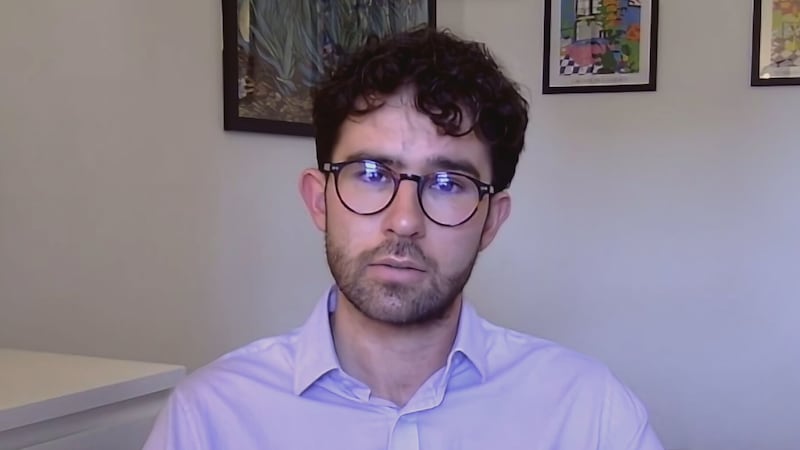
Read the full transcript below:
LINDSAY: Canada had a stronger-than-expected performance in the retail sector for March. However, the growth was entirely driven by higher fuel prices. Stats Canada says retail sales showed a monthly increase of 0.9 per cent. So, let’s get some perspective from Bradley Saunders, North America economist at Capital Economics. It’s great to have you join us. Thanks so much.
BRADLEY: Thanks.
LINDSAY: So, you say the results that we’re seeing are ugly, but not as bad as you feared. Tell us more.
BRADLEY: Yeah, I’d say that’s fair. So, as you say, there was a 0.9 per cent rise in value terms. In volume terms, that was a 0.7 per cent fall, given that almost all of that boost came from higher gasoline prices. But if we look back to where we were last month, it could have been the case that it was as large as one per cent. So, yeah, maybe not as bad as feared. The reason for that being we knew what was going to happen to gasoline station sales, so it was a case of what would happen to sales in other parts of the economy. Would Canadian consumers cut back on discretionary spending elsewhere, given they were paying more for their gasoline? And we saw a bit of mixed evidence on that. So, in some areas, like furniture, for instance, we saw sales slipping. In other parts, like electronics and clothing, sales are still doing fairly okay. So, I think, on the whole, as I said, we saw this contraction in sales volumes, but, yeah, not as ugly as feared.
LINDSAY: The Bank of Canada is announcing its next rate decision on June 10, so it’s actually coming up. What do you think the Bank of Canada will be looking for in the March data? Because obviously we’ve heard Tiff Macklem talking about higher fuel prices and what that’s going to do for the economy.
BRADLEY: Yeah, exactly. They’re looking for areas of weakness, areas in which it looks like households might be cutting back in discretionary spending. I think what’s important is that the bank has been pointing out repeatedly since the Iran war started that this is not the same backdrop we were in in 2022, when Russia invaded Ukraine and energy prices spiked as well. Part of that is that we don’t have this post-pandemic surge in spending fuelled by stimulus. So, I think, as I say, they’ll be looking for those areas of discretionary spending in the report and trying to find evidence that although we have higher oil prices, we don’t have the backdrop of a growing economy at the same time, which could lead to inflation becoming a more sustained issue.
LINDSAY: Yeah, because you’ve also pointed out that advance estimates for April, paired with the CPI data, suggest sales volumes were flat last month as well.
BRADLEY: Yes, exactly right. It seems that the pickup in spending we saw at the start of the year, back in January and February, now looks like the Iran war was really going to stop that.
LINDSAY: What about the impact of tariffs and the war in Iran? How much will that weigh into the next rate decision, do you think?
BRADLEY: It’s definitely a factor. I mean, that’s something we saw at the latest Bank of Canada meeting, where I think the bank was not afraid to sound a bit more hawkish. Perhaps there was talk of if oil prices were to rise further and remain elevated, then even consecutive rate hikes could be on the cards. I think almost every time the bank said something on that front, it then cautioned that there is the CUSMA renegotiation coming up. There is a consideration of where tariffs will go from here, and it’s about weighing those two options up. I think the main point being, as I said, that the bank has been repeatedly saying this is not the backdrop of 2022. The bank wants to be patient and wait and see how things are playing out for now, and I think it has the economic conditions to do that for the time being.
LINDSAY: For the time being, but for how long, do you think? When do you think maybe we could see a change, potentially a rate hike? I know some people have been saying not until 2027. Do you agree with that?
BRADLEY: That’s our view at the moment. Admittedly, in the last couple of months, things have begun to shift a little bit, particularly, as I said, given some of the more hawkish messaging from the Bank of Canada. I think we had the summary of deliberations from the most recent meeting the other day, and they said there was scope to be patient for the time being. So, I think the next meeting likely looks like a hold as well. It’s a case, then, of when we get to July, what situation are we in with the Strait of Hormuz? Where is the price of WTI? I think that really is a case of if we’re still around US$100, then perhaps we could see hikes toward the third or perhaps fourth quarter. But, as I say, it depends massively on where the war is going, which at the minute just seems so unclear.
LINDSAY: Yeah, and artificial intelligence is really starting to reshape the North American economy. How do you think central banks are making assessments in real time with that in mind?
BRADLEY: Yeah, it’s certainly a big factor. It’s something the bank talked about in its latest monetary policy report and sort of revising its long-run potential output considerations. We’re seeing a lot of that in the U.S. with the incoming Fed chair, Kevin Warsh. It’s a point he’s been making, similar to what was made during the dot-com era, that we are in a period of a fast-growing economy and there is this new general-purpose technology, which should massively improve productivity. That then could call for perhaps a lower neutral rate of interest.
LINDSAY: Oh yeah, I wanted to ask you about Kevin Warsh before we wrap up here. He’s getting sworn in today as the next chair of the Federal Reserve, of course. Your thoughts on the path for Kevin Warsh moving forward?
BRADLEY: It would certainly be a tricky one. We still think that the Fed will stay on hold this year. We’ve been taking that view for a while now. I know markets have shifted over now to expecting one hike. I think that, given we’re in a similar situation to Canada, where inflation at the moment is not broad-based, there is scope for the Fed to be patient for the time being. But I think when we saw the minutes from the Fed’s meeting earlier this week, we saw that Kevin Warsh is inheriting a pretty fractured FOMC. I think he was going to struggle to make friends coming in anyway, given the circumstances in which he’s come in and the difficulty around Jerome Powell choosing to stay. But I think, for now, this does look like it’s going to be a much more hostile environment for him. There’ll be hawks and doves arguing back and forth, but on net, I do think the Fed, for now, will stay on hold for the time being.
LINDSAY: And then how does that really impact the Bank of Canada moving forward? Does it at all, in terms of decisions that are made down south?
BRADLEY: Historically, that certainly has been the case. I think in the last couple of years we’ve seen such significant shocks to the two economies from the pandemic and now two oil price shocks. I think especially when it comes down to the CUSMA renegotiation, given that we can have such contrasting fortunes for the two economies, it seems like the two central banks’ interest-rate paths really have structurally come apart for the time being. So, I don’t think necessarily the Bank of Canada would take too much direction from the Fed for now.
LINDSAY: Okay, Bradley Saunders, North America economist at Capital Economics. Appreciate your time. Thanks for joining us.
---
This BNN Bloomberg summary and transcript of the May 22, 2026 interview with Bradley Saunders are published with the assistance of AI. Original research, interview questions and added context was created by BNN Bloomberg journalists. An editor also reviewed this material before it was published to ensure its accuracy and adherence with BNN Bloomberg editorial policies and standards.

