U.S. stocks are poised to open higher on optimism surrounding a possible Middle East peace deal and the reopening of the Strait of Hormuz, while bond yields retreat after a recent selloff. One strategist says volatility is likely to remain elevated even as investors find opportunities in fixed income.
BNN Bloomberg spoke with Earl Davis, head of fixed income and money markets at BMO Global Asset Management, about why he is adding duration exposure, maintaining a credit overweight and expecting central banks to hold interest rates steady through the remainder of 2026
Key Takeaways
- Recent increases in U.S. Treasury yields have created attractive opportunities for investors to extend duration exposure in fixed income portfolios.
- The Federal Reserve is still viewed as having an easing bias despite geopolitical risks and the potential for higher energy-driven inflation.
- Strong equity gains and continued fiscal spending are expected to support economic growth in both the U.S. and Canada through the rest of 2026.
- Credit markets remain attractive because resilient growth is expected to keep corporate default rates contained, despite elevated valuations.
- The Bank of Canada and the Federal Reserve are expected to keep interest rates unchanged through the balance of 2026, although persistent inflation could reopen the door to hikes in 2027.
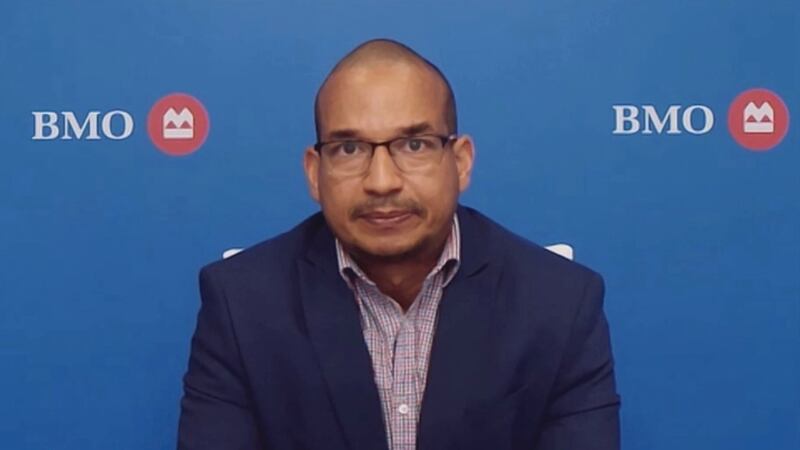
Read the full transcript below:
LINDSAY: U.S. stocks are poised to open higher on hopes of a Middle East peace deal and the reopening of the Strait of Hormuz. Meanwhile, the yield on the 10-year U.S. Treasury, which is the key benchmark for U.S. government borrowing, fell more than six basis points. Let’s get some perspective on that now. Joining me is Earl Davis, head of fixed income and money markets at BMO Global Asset Management. Good morning. It’s great to have you join us.
EARL: Good morning. It’s always a pleasure.
LINDSAY: Why is there so much pressure on Treasury yields right now, particularly long-end yields?
EARL: Initially, we had a big selloff in long-end Treasury yields. If you look at U.S. 10-year yields, they sold off basically 30 basis points in almost a one-week time frame up to last week. But at that point, we started buying because we thought they were overdone and oversold.
When you look at the last two years, we’re at the higher end of the range, so we think it’s a good opportunity now to extend duration because there could be a resolution in Iran, and that would further reduce Treasury yields because then easing comes back onto the table in the U.S. If you take out the inflationary aspect of the Iran war, then you could see Kevin Warsh really pushing for easing. So, I think that comes back onto the table, and that’s a reason to own Treasuries here.
LINDSAY: What if there isn’t a resolution to this war anytime soon? We keep hearing talks of peace deals, but obviously that continues not to be the case over the long run. What if this conflict continues for another couple of months?
EARL: We think that if the conflict continues for another couple of months, it still makes sense to own Treasuries here. We don’t think inflation, even though it will show up in CPI and other data, will really make headlines until September.
The reason is that central banks will push back on inflation now, essentially saying it is transitory without explicitly using that word, while resting on the possibility of a deal. We believe the Fed still has an easing bias. They haven’t taken that easing bias off the table, so we believe they’ll push through until the fall with that view.
Then, at that point, if we still see inflation in September and October, the argument changes because inflation would then appear persistent.
LINDSAY: It sounds like despite the impact from the war in Iran, you remain positive on growth in the U.S. overall.
EARL: Yes, very positive on growth in the U.S. It almost becomes a self-fulfilling prophecy in the sense that in April and May, the rally we’ve seen in the S&P 500 is equivalent to $10 trillion to $15 trillion in new wealth.
That wealth effect will keep things buoyant and make people feel good about growth and spending, so we think the wealth effect will be very supportive of the economy. Add to that the fact there is still a lot of fiscal spending. The wealth effect impacts the private sector, while fiscal spending supports the public sector. When you have both engines roaring, it’s very supportive of growth going forward.
LINDSAY: What about Canada for the rest of 2026? Are you feeling as optimistic on that front?
EARL: Optimistic, but not as optimistic. The reason is that 70 per cent of our trade is still done with the U.S., so our constructive outlook for U.S. growth is positive for Canada.
However, we have a lot of uncertainty in Canada right now. First it was Carney, and now it’s Alberta. As long as Alberta and that referendum in September remain on the table, that adds uncertainty in Canada. It delays foreign investment because investors want to see the impact of that.
So, we think the summer should still be good because of the U.S., but less so than in the U.S.
LINDSAY: It’s interesting to see how talk of separation there could factor into things moving forward. Is now a good time to have more investment in credit, such as corporate bonds?
EARL: There are two sides to that. Yes, we are overweight credit. Having said that, valuations are very high, so there’s very little margin for error.
We feel positive because our outlook on growth is positive. Positive growth means default rates among companies don’t jump higher. That’s why we like owning credit. Also, given that Treasuries are at the higher end of the yield range, you add the credit spread onto that.
So although credit spreads and valuations are very high, the all-in investment yield is still attractive. There are a lot of reasons to be supportive of credit, but valuations are high, so we’re overweight and maintaining that position.
LINDSAY: On the flip side, is there anything you’re trying to stay away from right now, or anything investors should avoid when factoring in uncertainties like the conflict in the Middle East or the referendum in Alberta?
EARL: Right now, we’re going everywhere. When you get really cautious, you usually want to stay away from high yield because it carries the biggest risk, the lowest credit ratings and the most debt. But our outlook on growth remains supportive of that sector.
Having said that, valuations are very high. We think they’re justified given the present scenario, but if they move even higher, which we expect as risk assets continue to rally, especially if there’s a deal, then we will slowly reduce exposure.
Not because we’re worried about the market, but because the one thing we know is going to remain is volatility. So, we’ll reduce exposure in order to buy back at better levels later.
LINDSAY: Both the Fed and the Bank of Canada are announcing rate decisions on June 10. Are you expecting easing, hikes or for things to stay the same at this point in 2026?
EARL: We expect things to stay the same, especially over the summer. Having said that, the market is discounting hikes in both Canada and the U.S. — more in Canada, surprisingly, than the U.S.
But we don’t believe there will be hikes in 2026. We believe rates will remain unchanged for the balance of the year.
LINDSAY: Unchanged for the balance of the year. I’ll ask you for a prediction for early 2027 then, because I have heard some analysts say they believe we could see rate hikes by then. Are you thinking along the same lines?
EARL: I wouldn’t rule it out. The reason I don’t fully agree with that yet is because we will reevaluate at the end of the year if inflation remains persistent from September through December.
We think rate hikes are a very real possibility in 2027. A lot depends on some resolution in Iran because that’s the driver of persistent inflation. It’s almost binary. That will determine whether hikes become more likely than easing.
LINDSAY: A lot can change between now and the end of the year. Earl Davis, head of fixed income and money markets at BMO Global Asset Management. Always good to have you on. Thanks so much.
---
This BNN Bloomberg summary and transcript of the May 26, 2026 interview with Earl Davis are published with the assistance of AI. Original research, interview questions and added context was created by BNN Bloomberg journalists. An editor also reviewed this material before it was published to ensure its accuracy and adherence with BNN Bloomberg editorial policies and standards.

