U.S. stocks have rallied through the first half of 2026, but investors are increasingly focused on whether leadership can broaden beyond AI as the economy settles into a slower pace of growth.
BNN Bloomberg spoke with Garrett Melson, portfolio strategist at Natixis Investment Managers, about why he believes the economic backdrop remains supportive for equities, why the recent weakness in AI is more technical than fundamental, and where investors may find opportunities in the second half of the year.
Key Takeaways
- The recent pullback in AI stocks appears to be driven more by investor positioning than weakening fundamentals.
- A broadening of market leadership into sectors such as industrials and biotech could support equities in the second half.
- The U.S. economy remains stable, but growth continues to track closer to trend than a sharp reacceleration.
- Labour market trends will be a key factor in determining whether the U.S. Federal Reserve maintains a tightening bias.
- The firm remains overweight equities and underweight fixed income, while seeing opportunities to add duration if bond yields rise further.
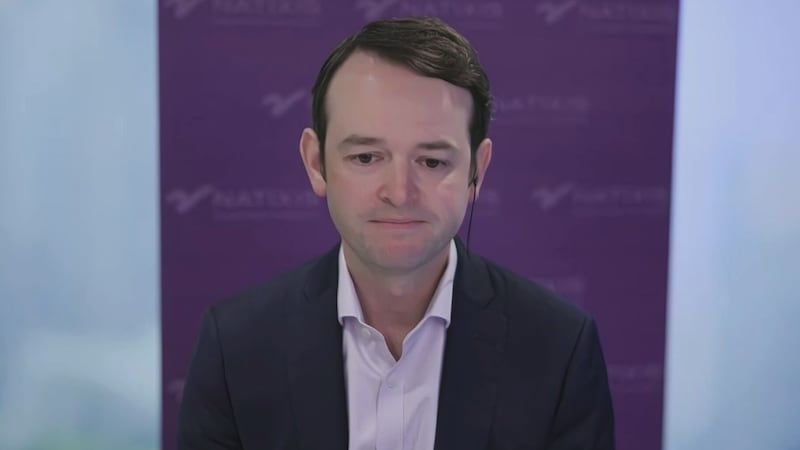
Read the full transcript below:
LINDSAY: Today marks the final day of the first half and the second quarter. The Dow has climbed 8.6 per cent in the first six months of the year. The S&P 500 is also up more than 8 per cent in the first half, while the Nasdaq has outperformed with an 11 per cent advance. Let’s get some perspective now. Joining me is Garrett Melson, portfolio strategist at Natixis Investment Managers. It’s great to have you join us. Good morning.
GARRETT: Thanks for having me, Lindsay.
LINDSAY: So, now that we’re at the kind of midway point of the year, what’s your take on the market so far and the direction right now?
GARRETT: Yeah, well, it certainly, to your point, has been a pretty stunning reversal in the second quarter. You know, I think that sets up some interesting things to keep in mind as we move into the back end of the year. You know, when you think about the broad macro backdrop, it’s still fairly supportive in here, you know. Growth, in our opinion, we’ve kind of coined the phrase “Ho-Hum Economy” for the U.S. here in 2026. It’s doing fine, you know. It’s not gangbusters growth, but it’s certainly doing just well enough to continue supporting, you know, solid earnings upside here, and then I think is underpinning the market. The issue is the result of stronger returns in the second quarter, I think, has led to some pretty serious crowding within the AI trade, and so it’s not necessarily a death knell to the sector. What you have certainly seen, going back to the beginning of June, has been a pretty sharp sentiment shift, a little bit of skepticism around the AI durability, and ultimately that started translating into some rotations. I think that ultimately is encouraging. You’re not seeing a wholesale liquidation and investors bailing on the AI trade and moving to cash. They’re simply moving to the laggards in here. And so that may be a theme that we have to continue working through to work off some of that excess sentiment and positioning, but ultimately I think the backdrop is still fairly supportive. End to end.
LINDSAY: Are there any indicators that signal any kind of shift in momentum as we head into the second half?
GARRETT: From a macro perspective, you know, we certainly have seen a stabilization in activity, especially within the labour market. So, an emerging narrative that has certainly grown in terms of strength over the last couple of months has been this idea that the labour market is reaccelerating. I think it’s a little too early to decisively declare that, and I think that’s really the key question for the economy moving forward. You know, we are seeing a lot of pillars of the U.S. economy that are somewhat still stuck in stasis. You know, you think of the housing market that really continues to go nowhere, non-AI capex really not doing much of anything, and the manufacturing rebound we’ve seen, I think, is probably more a function of inventory restocking than a really durable cyclical reacceleration. And so that boils down to the labour market and really into consumption. Here, I think the big question is, are we just seeing a stabilization, or are we actually starting to see some signs of labour intensity in terms of hiring, as well as wage growth reaccelerate? I think it’s a little bit too early to declare that, but if we start to see that, you know, that certainly suggests we’re seeing some increasing momentum in the economy, and that again starts to open up the door to question marks around the Fed’s policy path moving into the back end of the year.
LINDSAY: We can maybe talk about that in a moment, but I wanted to get back to, because I was going to ask you about your thoughts on the AI narrative. You’ve already talked about that a bit. You say there’s some serious crowding in the AI trade right now, and I wonder what you think that could do to the markets. Like you talked about how we’re seeing a bit of a rotation out of that. Is that the main, I guess, cause of what we’re seeing?
GARRETT: Yeah, I think it is. There certainly has been some skepticism that’s emerged. We’re hearing a lot of kind of narratives to kind of justify the weakness. I think it’s far more technical in nature than any sort of fundamental reassessment of the outlook. You know, we are starting to hear some chatter about, you know, cash flows, you know, capex eating up cash flows, and so you’re starting to hear some of that chatter that we heard late last year when the AI complex consolidated for, you know, five, six months. So, you know, I think that’s really just trying to back into the price action, which again is more of a technical factor in here. And, you know, when you think about the AI trade, it’s basically become the momentum trade and the beta trade all wrapped in one. And so we see this time and again. When prices move higher, it tends to draw in inflows, and you eventually get to a point where you have some excess optimism and excess positioning, and I think it’s just a matter of working off some of that as we go over the couple of months in here. That’s not necessarily a death knell to the economy or to the markets, I should say. You know, obviously some of the major weights in here are going to be a little bit of a headwind for the major headline indices, but on the whole, you know, I think it’s something that we can deal with, and ultimately under the surface, I think that fundamental story is still very much intact. So, still, in our opinion, much more of a technical consolidation than anything else.
LINDSAY: So, where are you finding opportunities in the market right now? If you’re looking at other sectors, if investors are looking to maybe rotate away from AI and tech, where do you think people should be looking?
GARRETT: Yeah, well, you know, I think you can’t throw the towel in on the AI trade, and so having at least a market-weight position there makes a whole lot of sense in our view. And I would just look at some of the sentiment shift, as well as some of the flows we’ve seen over the last couple of weeks or two. You’ve seen a pretty marked reduction in some of the net and gross risk for a lot of systematic strategies. They tend to be the more important drivers for day-to-day movements in some of these technical oscillations in the marketplace. So, from that perspective, I think you’ve already worked off some of that excess positioning. But when you look more broadly outside the AI complex, you know, I think there are some opportunities which are still very much within the cyclical complex. Obviously, the industrial trade is still very much wrapped up in terms of building out that infrastructure for AI, and I think that’s still going to continue to be supported by a fairly decent macro backdrop. But there are some other opportunities out there within the growth complex. Think about where investors tend to gravitate when there’s some skepticism around tech. You start to see some of that flow into what might be a little bit more defensive growth, which you can certainly find within the biotech space, and that’s been basically a straight line higher over the last couple of weeks in here. So, there certainly are some areas to pick out, you know, relative laggards, but also areas that continue to benefit from a macroeconomy that’s holding up just fine.
LINDSAY: You are underweight, though, in fixed income. What’s your thesis on that?
GARRETT: So, that’s really just a byproduct of a broader risk-on stance, right? So, as long as the economy continues to hold up in here, the AI trade is doing just fine, you know. I think it still speaks to a risk-on tone for markets, and so from that perspective, you know, keep it simple, that’s still a pretty healthy backdrop to be overweight equities, and so that’s certainly going to be financed and funded through an underweight to fixed income. I do think that there’s an opportunity, you know, for potential overshoot to develop within fixed-income markets. On the rate side, you know, we’ve kind of come off the edge in terms of backing up in yields a couple of times now over the last few months. Obviously, part of that story is oil prices and energy prices coming back down here. If we do start to see, as I mentioned, that reacceleration in the labour market, though, I think you’re probably going to start to see the market price in higher odds of hikes and not necessarily just one, and so that’s going to probably bleed out the curve to a degree. But in our opinion, that’s probably an opportunity to lean back into duration. So, at the portfolio level, overweight equities, underweight fixed income, but I think there are some opportunities here as you look over the next couple of months to start leaning back into duration, especially out the curve.
LINDSAY: All right, we’ll leave it there. Garrett Melson, portfolio strategist at Natixis Investment Managers. Appreciate your time this morning. Thank you.
---
This BNN Bloomberg summary and transcript of the June 30, 2026 interview with Garrett Melson are published with the assistance of AI. Original research, interview questions and added context was created by BNN Bloomberg journalists. An editor also reviewed this material before it was published to ensure its accuracy and adherence with BNN Bloomberg editorial policies and standards.

