Geopolitical tensions, elevated interest rates and lofty expectations for artificial intelligence are expected to keep volatility elevated through the second half of the year. As earnings season begins, investors will be watching whether technology companies can justify rich valuations and maintain strong profit growth.
BNN Bloomberg spoke with Michelle Connell, president and owner of Portia Capital Management, about why she expects volatility to continue despite remaining optimistic on the long-term outlook. She also discussed her investment approach and highlighted Broadcom, Dell and Eli Lilly among her preferred stocks.
Key Takeaways
- AI-related stocks could face continued volatility as investors assess whether earnings and guidance justify elevated valuations.
- Higher interest rates and heavy borrowing tied to AI infrastructure spending could limit equity gains in the second half of the year.
- Investors should focus on valuations, cash flow and profit margins rather than broad market momentum.
- Active portfolio management may outperform passive investing as performance becomes more dependent on company-specific fundamentals.
- Michelle Connell’s preferred stocks are Broadcom, Dell and Eli Lilly, citing AI infrastructure, competitive advantages and strong cash flow generation.
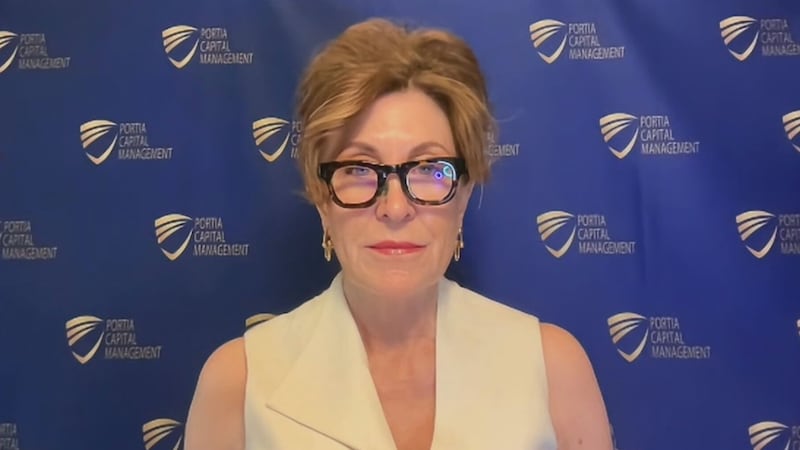
Read the full transcript below:
LINDSAY: Stock futures are sharply lower after U.S. President Donald Trump told the NATO summit in Turkey that the ceasefire with Iran is over. Energy stocks have advanced, while chip stocks are extending their latest pressure. Let’s get some perspective now. Joining us is Michelle Connell, president and owner of Portia Capital Management. Good morning. Great to have you join us.
MICHELLE: Thanks for having me, Lindsay.
LINDSAY: So, let’s start with what’s been happening in the Middle East. Do you think investors are maybe overreacting to the latest headlines, or are the risks already kind of priced in?
MICHELLE: I think we’re tired of this going back and forth in terms of Trump saying that things are settled, then they’re not, and underlying all that is investors’ and consumers’ concerns that inflation will stay high. You know, we’ve had this respite with oil pulling back, but will that continue? And at the same time, we all have other parts of inflation flaring, caused by the AI buildout of electricity, etc. So people and investors are nervous here.
LINDSAY: Well, let’s talk about the AI buildup and the AI trade in general, because it appears to be back in full swing, but chip stocks in particular are still under some pressure once again. What’s your take on what you’re seeing there?
MICHELLE: Well, since June, you’ve had the Nasdaq pull back about five per cent or more, and the S&P 500 only about one per cent, so they’re about even for the year, both up about 10 per cent. And the reason why we’ve had that vast pullback is that so many of the Nasdaq stocks, especially the semiconductors, which you just mentioned, they have just roared ahead this year. So investors are taking money off the table, especially if there’s a concern that not just the demand but the profit margins are going to maintain where they have been in the short term. Can that be maintained for the long term?
LINDSAY: We’re also waiting for earnings season, which really gets underway next week, starting with the big U.S. banks. What will you be watching for in terms of that, and also related to stocks related to AI?
MICHELLE: Well, we’ve seen the financial stocks do really well, and part of that has been because of the amount of money they’ve made on the investment banking side. You look at how much was made with SpaceX and what’s going to be made as more of these technology IPOs roll out. So Goldman Sachs and Citi, etc., they’ve done extraordinarily well. I think Goldman’s up 50% and Citi is up 30%. So I think those stocks have done well, and I think it’s also a bit of a rotation because there has been such an emphasis on owning tech. So investors are like, okay, how can I balance out my trade here or my investment risk, and what should I own instead?
LINDSAY: Do you think we’ll see market volatility through to the end of 2026? We’re already getting into the second half now. Like, what do you think is going to happen?
MICHELLE: Yeah, it’s hard to believe how fast it’s gone. Yes, I do, because I don’t think interest rates are going to go down, nor do I think they’re going to go up. But underneath the Fed rate and the other interest rates around the world that are set by the banking systems, you have this surge of debt that’s being issued by the hyperscalers, and when that happens, interest rates in general stay where they are or actually can go further up the yield curve. So, with that being said, if interest rates stay where they are, and we’ve had the stocks do as well as they have in the last two years, I think stock prices will probably be muted in terms of performance, because ultimately stock prices are based and valued on the cash flows of those interest rates. If interest rates stay high, I don’t think we have the euphoria that we’ve had in the past.
LINDSAY: You say if interest rates stay where they are, is it harder today to predict what’s going to happen in terms of the rate path moving forward than it was yesterday before everything really started to happen in the Middle East once again?
MICHELLE: I think that helps add to the uncertainty, but then you have Warsh and his feelings about pulling back or dialing back the amount of communication that the Federal Reserve is allowed, or what he’s comfortable with. We’ll see that today, actually, because I think that we’re going to have minutes being released, and maybe we’re going to have less information, and markets don’t like it when they have less information. So that makes us nervous, so that’s going to add to some uncertainty too.
LINDSAY: Okay, I did want to get to some of your stock picks, because you do have a couple. You say you still like technology companies that have competitive edges, and you’ve got two. We’ll start with the first one. It’s Broadcom. Tell us why you like Broadcom.
MICHELLE: I like Broadcom for a long time, just because they’re not a commodity chip, like the memory chips. They focus on customized AI chips. They just extended their agreement with Apple that was announced this week. Their strategy with Apple will be pushed through 2031 for their chips that are used in their phones and their other products. So I think this stock, in the long term, looks very compelling, and since June 4 it’s pulled back quite a bit when the expectations weren’t quite as high. So if you pick your entry points with these very volatile stocks, you can do well in the long term.
LINDSAY: You also like Dell. Tell us more about what opportunities you’re seeing there.
MICHELLE: I also like Dell because they’ve got a competitive moat with their AI servers, and management has come out and said that they believe that moat will increase with their next generation of servers that are rolling out. And they’re very good at their supply chain and keeping their costs down, and the market continues to be focused on costs, memory chips and other types of costs. And because of the size of Dell, they’re just a behemoth. They will do well in the long term too.
LINDSAY: And then, switching to a completely different sector, you’ve got Eli Lilly as one of your top picks as well. Tell us about your investment case there with this company.
MICHELLE: Probably like any other investor, Lindsay, I like having some risk diversified, right, especially right now. So Lilly has a big war chest because of the GLP-1 drugs. Their free cash flow is anywhere from $8 billion to $10 billion that they’re generating, and like a lot of other large pharma companies, they’re using that cash war chest to buy small biotechs that can continue to give them that competitive edge and that drug pipeline from the biotechs.
LINDSAY: Well, because I wonder too, like, how much more of a run Eli Lilly has, in terms of the competitors and all the other companies that are really starting to come forward with similar drugs. Do you think that competition is going to be a big headwind for Eli Lilly in the future?
MICHELLE: I think it’s a big headwind for any large pharma, and that’s why it’s very important that they use that free cash flow to continue to build out their drug pipeline, because you can’t depend on one sector of drugs. That’s the death knell for these stocks in terms of performance. So tucking in and buying very strategic biotech stocks, that’s why you’ve seen the biotech stocks start to do well in the last quarter. That will provide them a continuation of a drug pipeline, especially in oncology and things of that nature.
LINDSAY: Okay, so those are some of the companies that you like right now. I wonder if there are any company sectors or commodities that you’re underweight in or that you’re cautious about, given all the volatility that we’re seeing right now.
MICHELLE: Industrials have done very well this year in general, as has defence. But when you look at the underlying expectations for growth, industrials are expected to grow right under technology year over year for earnings through the end of June. So some of those stocks that have done very well, I’m thinking like Caterpillar, et cetera, they may be overextended here. So, like anything, you really have to know what you own and be active in terms of what you own and in your rotation.
LINDSAY: All right, we’ve got to leave it there. Michelle Connell, president and owner of Portia Capital Management, appreciate you joining us today. Thanks so much.
MICHELLE: Thanks, Lindsay.
---
This BNN Bloomberg summary and transcript of the July 8, 2026 interview with Michelle Connell are published with the assistance of AI. Original research, interview questions and added context was created by BNN Bloomberg journalists. An editor also reviewed this material before it was published to ensure its accuracy and adherence with BNN Bloomberg editorial policies and standards.

