The outlook for 2025 was pointed to a gentle slowdown in growth, but for a strong wealth effect with booming asset markets.
An agenda of disruptive policy change by the new administration shook the world economy in Q2 following the post election boost. At its worst moment, consensus growth expectations for the U.S. reached a low of 1.4 per cent in May. This was a drop of almost a full percentage point from the peak of 2.3 per cent in February, a significant downgrade in a short period of time.
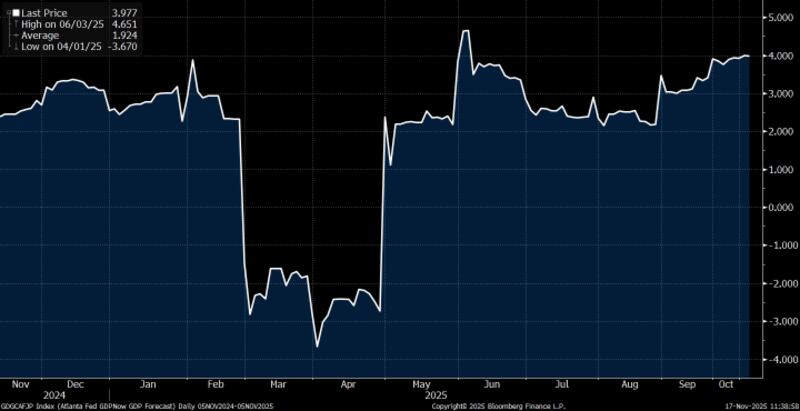
Since peak pessimism in May, economic indicators have stabilized and, more surprisingly, some gauges even point to an acceleration in activity. The “GDP Now” is an informative real-time, model-based “nowcast” produced by the Federal Reserve Bank of Atlanta, which delivers a running estimate of real GDP growth in the current quarter for the U.S. economy. It leverages a large set of high-frequency indicators, from key economic sectors, and is therefore a representative summary of economic conditions. The latest available estimate points to an annualized growth rate of almost 4 per cent in Q3-2025, a significant re-acceleration in activity relative to the 0.6 per cent contraction in Q1-2025.
This is causing some on the Federal Open Market Committee (FOMC) to question the path of future rate cuts. They do not want to see inflation accelerate that we often see with above trend growth.
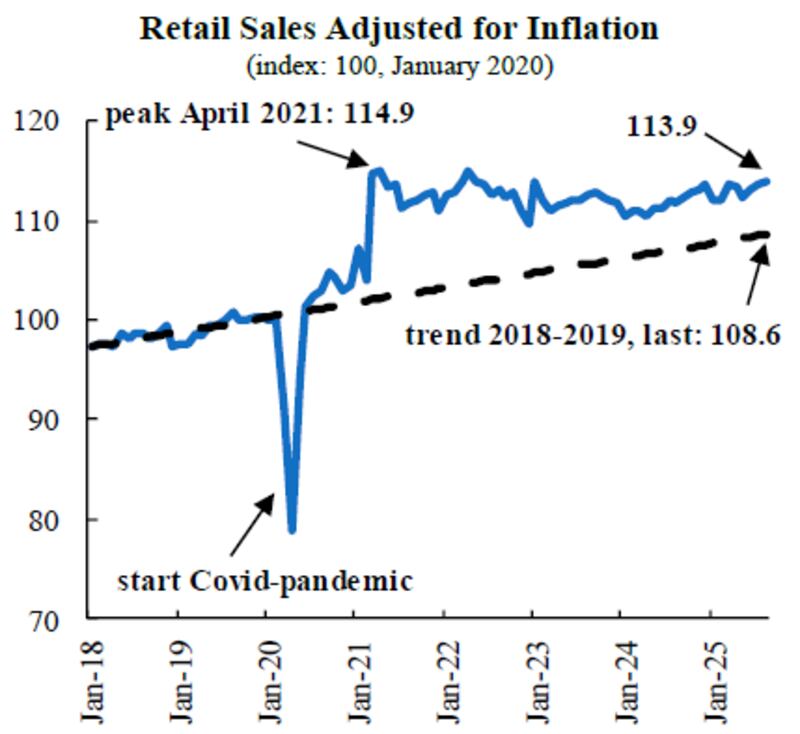
Household consumption is providing a strong boost to U.S. real GDP growth, underpinned by the combination of resilient, even if deteriorating, employment, record household net wealth, and adequate access to credit. Consumption represents close to 70 per cent of GDP and is therefore a major driver of economic growth. Retail sales adjusted for inflation, a useful gauge of consumption strength, accelerated to 1.7 per cent year-over-year according to the latest prints, significantly above the average of -0.3 per cent from last year.
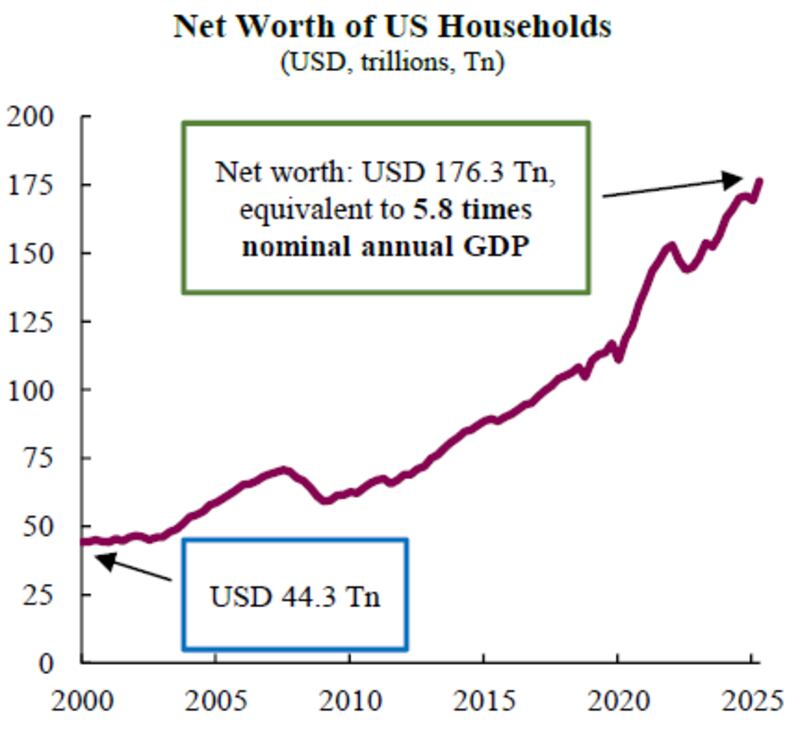
The chart below highlights the wealth effect that is translating into consumption. Interestingly enough, consumer confidence surveyed is very weak. Something certainly does not add up.
Even as job gains have slowed, the unemployment rate at 4.3 per cent remains in the range of balanced and full employment, and earnings have steadily grown in real terms, outpacing inflation. This helps to keep aggregate household incomes strong.
At the same time, a positive wealth effect from rising stock markets has bolstered spending capacity. Directly and indirectly held equity represents 35 per cent of household net wealth, and 14 per cent year-to-date growth in major indices have a significant impact on wealth, providing a positive effect that bolsters consumption sentiment.
Borrowing channels also remain dynamic, with total household credit growing USD 352 Bn in the first two quarters and continuing to support expenditures this quarter. Together, these factors are contributing to maintain household consumption as the key driver of real GDP momentum, accounting for 2/3 of real GDP growth expected for this quarter.
Business investment is showing a strong performance as well, on the back of favourable financial conditions, fiscal incentives, and technology and AI-related capital expenditures. The latest data releases have shown accelerating growth in “core capital goods orders,” a timely and representative signal of private-sector capital expenditures (“capex”). This measure tracks non-defence capital goods and excludes aircraft orders, which are typically sensitive to irregular procurements, and are therefore noisier. In recent months, this indicator is growing at a rate of close to 4 per cent in annual terms, a remarkable acceleration from the 0.9 per cent average contraction last year.
Several factors are contributing to investment growth. Demand for equipment and technology is surging, as firms continue to invest to support productivity and AI-related expansion. Policy incentives, such as the CHIPS Act, the Inflation Reduction Act, and infrastructure programs are spurring construction of semiconductor facilities, factories, and clean energy projects. Additionally, healthy corporate profits and high expected returns on invested capital give businesses the means and the incentives to move forward with long-term projects. Taken together, these investment trends are contributing to an acceleration of economic growth.
All in all, a reacceleration of the US economy is taking place on the back of strong momentum in consumption and private investment. With forecasts for 2026 now in focus, many are considering an even higher pace of earnings growth. So far the few forecasts in EPS for the S&P 500 for 2026 are in the US$300 to US$310 range with US$267 the expectation for 2025. With this emerging outlook, it makes sense for the FOMC to pause on rate cuts until we see what Q1 is going to look like.
The U.S. stock market should pause the rally for now.

