How do you know when correction is over? You don’t, until way after the fact.
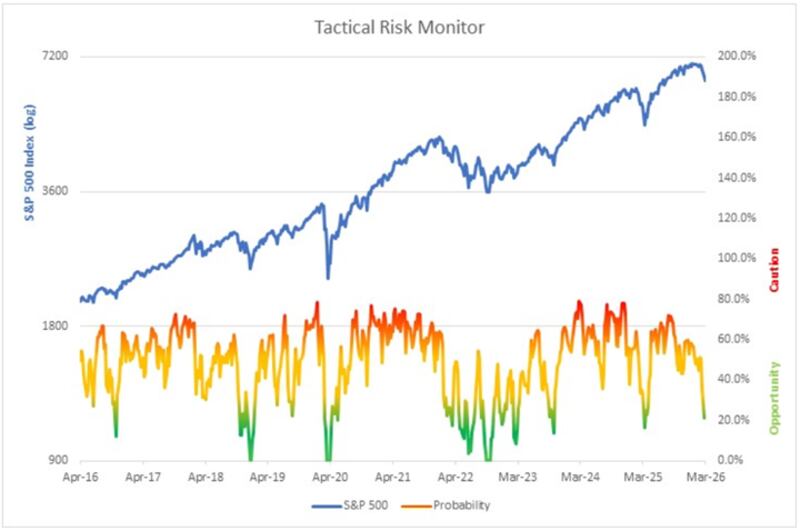
But if you think about the opportunity in probability terms, it can help how you think about your dollar cost averaging. Our Berman’s Call Pro-Eyes tactical indicators suggest we are in a zone of opportunity after the recent sell off.
What we don’t know is will it be a 2022 to 2023 bottom or more like 2016, 2018, 2020 or 2025? For this, we think about what is the current fundamental factor driving markets. The correction phase in 2022 to 2023 was a rate hike cycle over a longer period of time versus other corrections that were more acute shocks like COVID-19 and tariffs that were quickly plugged with a policy response.
The most likely scenario we see is that the war will not end until there is regime change in Iran. The U.S. is in control of the Strait of Hormuz and disruption to world supply of oil and gas is mitigated. This probably takes several more weeks or months. We do not see this lasting more than a few more months, but we could be wrong. So, it’s likely somewhere between the acute COVID-19/tariff shock declines and the elongated rate hike cycle but leaning more towards a shorter resolution.
With this lens, a common estimate is a retracement of the previous rallies. The 61.8 per cent retracement of the 2025 to 2026 rally is near 5650 and the 38.2 per cent retracement of the 2022 to 2026 rally is in the same area.
Barring an elongated war and mass U.S. casualties and persistent oil prices above US$100, we could see it much worse. Interestingly enough, analysts are still upgrading earnings outlooks for 2026 and 2027, which seems counter intuitive at this point.
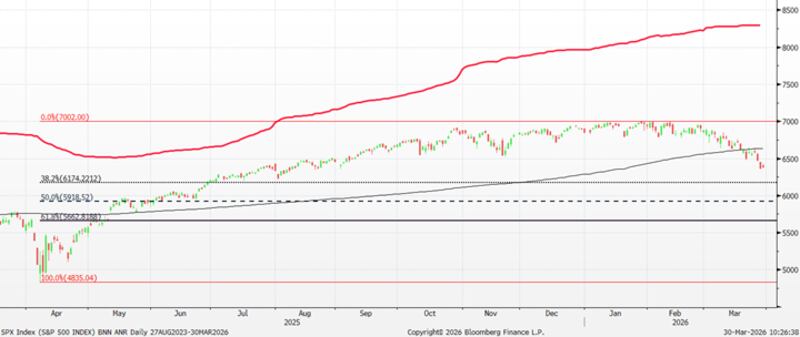
For investors with dry powder looking to put money to work, we always recommend scaling into weakness. A move to 5900 seems likely if the war drifts into May with no significant progress on opening the Strait. It seems the game plan is fluid and Kharg Island is the next target. Iran’s offensive abilities appear degraded over the past few days.
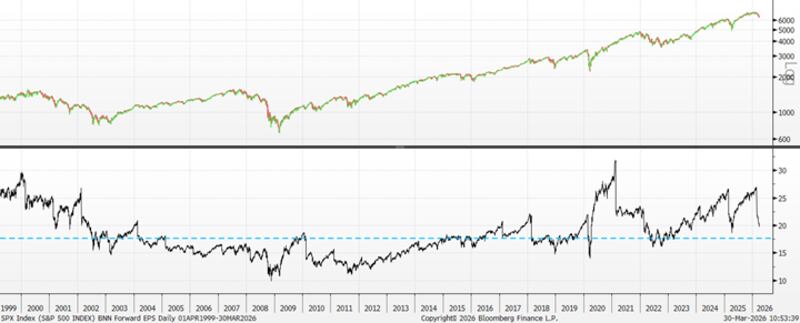
Fundamentally, we can look at forward price earnings (p/e) ratios and where the market bottomed historically. The median since 1999 is around 17.5, but you can see that it’s never bottomed there. Fifteen times earnings was an area that was more frequent with 19 to 20 times in recent years. This supports the range of 5650 to 5900 as where the bottom probably develops if the war last another month or so.