
Proper portfolio construction should be able to withstand most any outcome. Obviously, shocks like COVID-19 and a world war are things you can’t shouldn’t plan for as they are extremely rare and unpredictable. But shocks will happen, both good and bad, and they should be used to rebalance portfolios back to meet long-term obligations (not to try and time markets). In other words, set it and don’t forget it (rebalance it).
My crystal ball is cloudy on must days. The essence of good financial planning will come with a robust portfolio that maximizes your potential. It’s not about trying to time and beat markets. It’s hard, I’ve spent most of my life trying with varying degrees of success. There have been a few years where I’ve literally be number one. Winning awards for being the best, but there are far more years where I’m somewhere in the pack with everyone else. It’s about getting the outcome that helps achieve your long-term goals that matter most. In recent years I’ve talked about alternatives like private credit and private equity that have their own challenges to be sure.
The smartest asset allocators in the world (think sovereign wealth funds and pensions plans), use another asset class called uncorrelated. Several very smart people have written extensively on the subject. One of them is Ray Dalio at Bridgewater another of my top thinkers include Cliff Asness of AQR fame.
Harry Markowitz in his Nobel Prize winning work from the 1950s provided the statistical underpinning for diversification in portfolio construction, but Ray Dalio took the idea one step further, emphasizing the value of specifically seeking uncorrelated return streams. He famously refers to this approach as the “holy grail” of investing, suggesting that if you can find 15 or more good uncorrelated strategies, your total portfolio risk can drop dramatically without cutting your overall return potential.
- Identifying or designing multiple uncorrelated strategies (e.g., strategies that focus on different sectors, market movements, or time frames).
- Ensuring each strategy has a positive expected return; that is, it tends to make more money than it loses over the long run.
- Combining these strategies in proportions that align with your risk tolerance and financial goals.
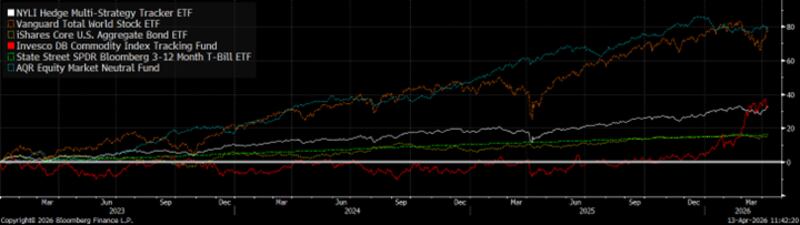
QAI is an ETF of ETFs strategy that wraps other asset class ETFs to help achieve what Dalio and others talk about when building portfolios. Trying to achieve a higher average return with less risk. AQR is a strategy that is not available in an ETF. It’s expensive as a two per cent management fee and 20 per cent performance fee, but it has delivered equity like returns with significantly less risk. They do it by combining assets returns that are uncorrelated. The QAI ETF is trying to replicate the idea of good portfolio construction.