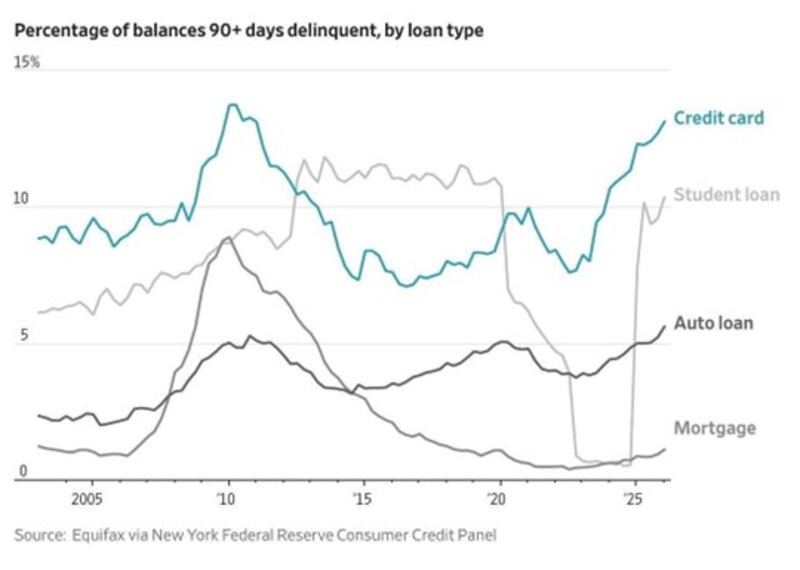
My friend Peter Boockvar (Highly worth following him) produced this chart in his daily note today. The problem with charts like this is that they are useless for investment decisions, though they are often great at setting the table for an eventual outcome. It is no surprise that the “K-shaped” economy is showing up in many places.
Some argue that the economy is broadening out, while others point to charts like this and say caution is warranted. Both perspectives are correct; it is simply a matter of time frame and catalyst. At a minimum, one would think it is probably time to get conservative when it comes to consumer-oriented exposure.
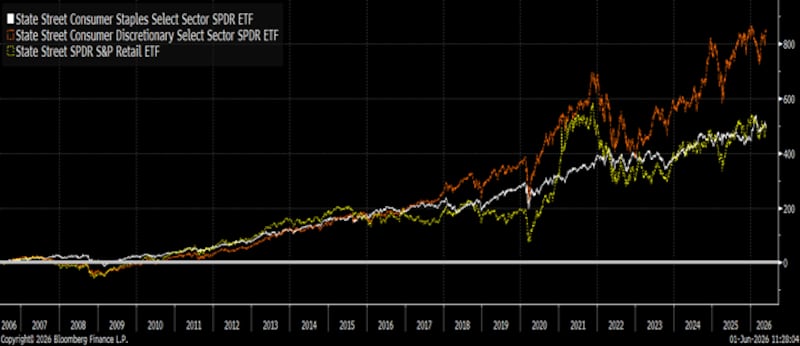
In the simplest terms, consumer stocks are divided into consumer staples (the “must-haves”) and consumer discretionary (the “want-to-haves”). Both sectors look expensive today when looking at their primary ETFs, XLP and XLY. XLP trades at roughly 30x forward earnings, while XLY trades at 35x.
The problem with these consumer-focused ETFs mirrors the broader economy: the market heavily favours heavyweights like TSLA (which makes up 20 per cent of XLY) at 225x earnings, while BBY trades at a modest 11.6x with a 5 per cent dividend yield. We see the same divergence within XLP, where COST trades at 46x while CAG sits at a mere 7.8x. Consequently, the more equally weighted retail ETF, XRT, is also expensive at just under 30x forward earnings. XRT comprises roughly 75 per cent discretionary and 25 per cent staples.
I love ETFs, always have, always will, but the bifurcated economy suggests that stock picking may come back for the next cycle where the economic outcome is more volatile. If you are looking to play defense, the consumer staples ETF may not be the place to hide for the next cycle, but many stocks in the group are now cheap and pay decent dividends.
We have suggested in recent years that when markets get expensive, active management can do better. Investors should give a long look to managers that try to deliver positive returns regardless of the market direction or value. PFMN (Picton Mahoney) has been out for several years and has delivered a good uncorrelated return since inception. We can expect to see more value-added active ETF strategies like these as market beta gets bifurcated. This bifurcation will only increase as SpaceX, Anthropic, and a few other trillion-dollar IPOs make their way in the indexes this year.

