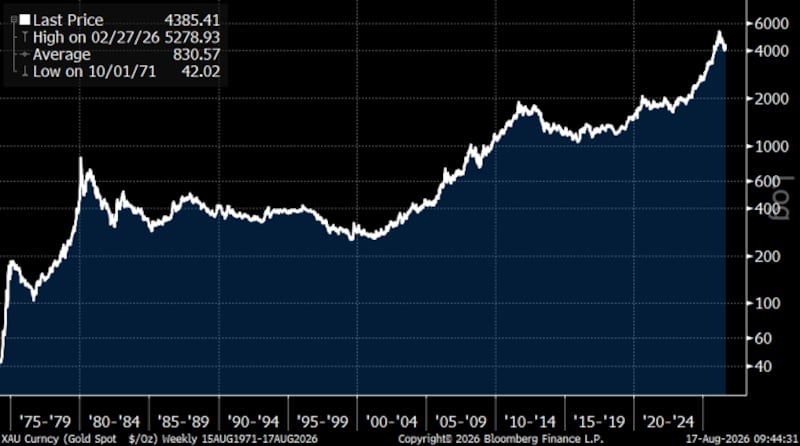
August 15th 1971, was the day that Nixon took the U.S. off the gold standard and initiated the start of irresponsible government spending!
I’m not a gold bug, but I wear lots of gold jewelry. That’s not speculative, but it’s nice to have the utility and the long-term appreciation at the same time. For most, that probably never changes, but it does fluctuate with price. Silver is also becoming more popular for jewelry these days as a cheaper option.
Back in 2014, I gave a keynote speech at the annual Gold Show in Dawson City, Yukon. They were not too happy with my multi-year view that the market would go nowhere. I was basically correct; it went sideways for about five more years. Those in the gold business are almost always bullish. In my forecast, I did say that due largely to the fiscal irresponsibility trends of governments all over the world and the fiat money system structure which inspired crypto (mostly scams) and stablecoins (new vehicles, same actors), gold would likely continue its role as an important store of value.
However, gold also has limits, in that a significant portion of its demand is speculative and for consumption. So, when prices go up relatively fast, natural demand from consumption cools. We can see long periods of consolidation throughout history. We are in one now, and it could last for years.
A google AI search reveals the following:
Global gold demand is primarily driven by jewelry, investment, central banks, and technology, with India and China leading consumption.
Key Demand Sectors
1. Jewelry fabrication
Jewelry remains the largest single source of gold demand, accounting for roughly 45 per cent of total global demand. India and China dominate this sector, together representing over half of global jewelry consumption. Jewelry demand is influenced by cultural practices, weddings, and festivals, with 24-karat gold particularly popular in China for both adornment and as a store of value
2. Investment
Investment demand includes bars, coins, and ETFs, making up about 28% of global demand. Investors often turn to gold as a safe-haven asset during economic uncertainty, inflation, or geopolitical tensions. In 2025, US-listed ETFs alone added 437 tonnes, pushing holdings to a record 2,019 tonnes, while India saw a 54 per cent year-on-year increase in bar and coin investment.
3. Central Bank Purchases
Central banks are significant buyers, accounting for roughly 22 per cent of global demand. Since 2008, central banks have been net buyers, with China, India, and Poland among the largest purchasers. Central bank reserves now represent about 17 per cent of all gold ever mined, totaling over 37,755 metric tons by the end of 2024.
4. Technology and Industrial Use
Gold is used in electronics, medical devices, and other industrial applications, contributing around five per cent of total demand. Its excellent conductivity, corrosion resistance, and biocompatibility make it valuable in high-tech and medical sectors.
It’s debatable when the era of fiscal irresponsibility started. Many point to Greenspan and the Fed put in the aftermath of the 1987 stock market crash, but more likely it was the ZIRP (zero interest rate policy) that started after the technology bubble deflated equities at the turn of the millennium. That low lines up much better with the gold bottom after the 20 years consolidation of the ear of higher real rates of interest.
In the coming decades, I expect central bank demand will remain strong. Industrial demand will be flat to lower as gold price rise, alternatives will likely be used.
Jewelry demand will fluctuate and then adjust as it always has, but that takes time and depends on rates of change and general income levels. It’s the speculative demand from investments that is beyond impossible to gauge. It’s fear and greed analysis at its pinnacle and at 28 per cent of demand, it drives the swing factor considerably. One thing is clear, government fiscal mismanagement is getting bigger an to that extent, the demand for gold from central banks and investment drive demand, the long-term trend MUST BE UP!!!!

