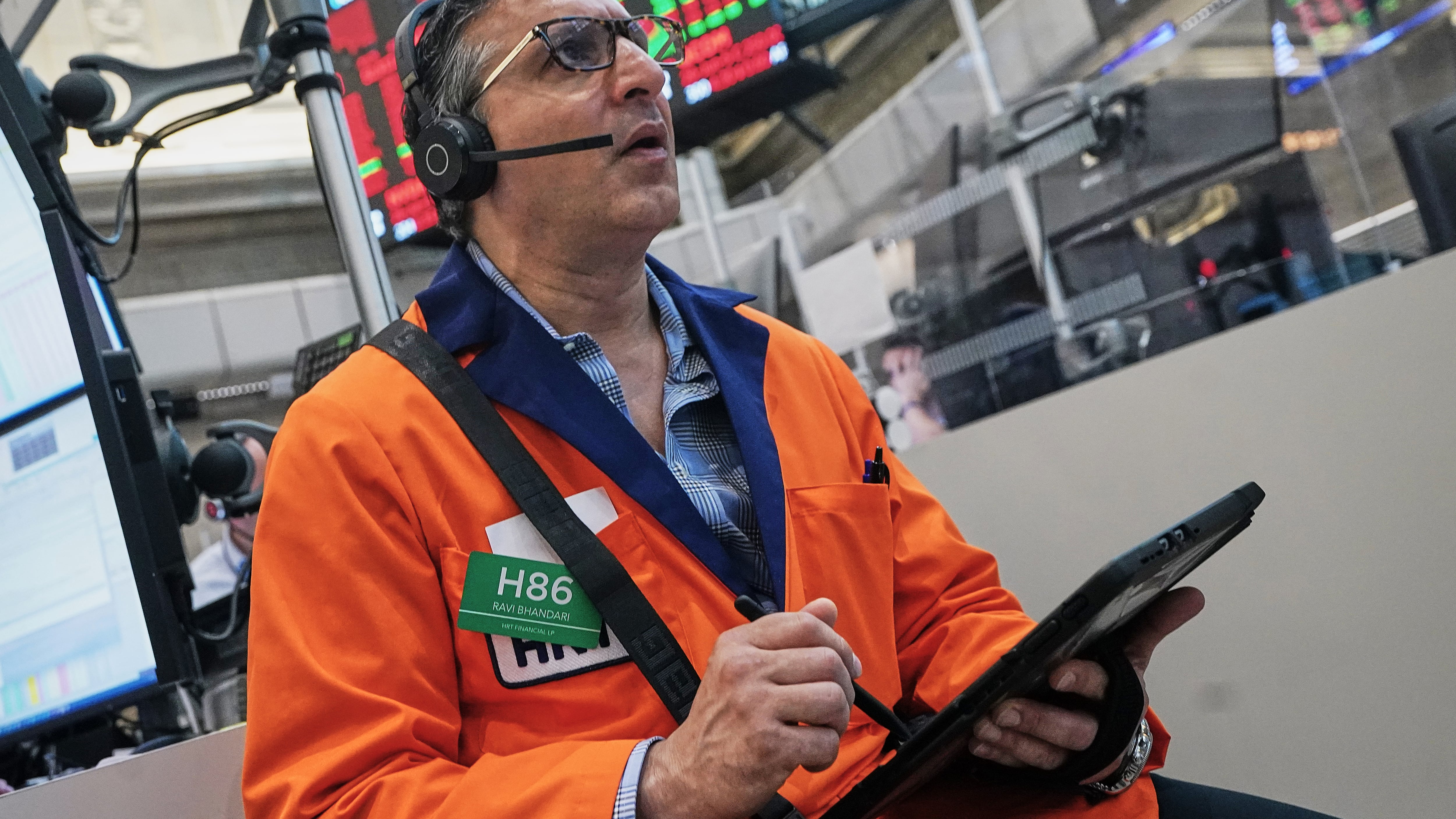
NEW YORK — Wall Street rallied Thursday after falling oil prices and yields in the bond market eased the pressure on U.S. stocks. Banks, small companies and other stocks that had earlier been left behind by the euphoria around artificial-intelligence technology led the way.
The S&P 500 rose 0.4 per cent for its 10th gain in the last 11 days, a day after dropping from its all-time high. The Dow Jones Industrial Average soared 874 points, or 1.7 per cent, to a record, and the Nasdaq composite slipped 0.1 per cent.
Stocks got a lift from a 2.8 per cent drop for the price of Brent crude oil to US$95.03 per barrel. That gave back a chunk of its rise from this week caused by the latest flare-ups of fighting between Iran and the United States and its allies.
The expectation on Wall Street seems to be that the United States and Iran will ultimately agree to reopen the Strait of Hormuz to oil tankers. That would hopefully improve the flow of crude, lower oil’s price and remove some of the upward pressure on inflation that’s hurting the world. Such hopes, along with strong profit reports from U.S. companies, helped launch the S&P 500 on a nine-day winning streak that ended Wednesday, a day short of its longest run in three decades.
Stocks of smaller companies helped lead the way, and the Russell 2000 index of the smallest U.S. stocks jumped 1.4 per cent. They can reap the biggest benefits of falling interest rates, and the yield on the 10-year Treasury dipped to 4.47 per cent from 4.49 per cent late Wednesday as oil prices sank.
Lower yields can make it less expensive for companies to borrow cash, which many smaller companies need to do to grow.
Banks also helped lead the market, including gains of five per cent for Goldman Sachs, 4.7 per cent for Fifth Third Bancorp and 4.4 per cent for U.S. Bancorp.
They helped to more than make up for losses by some AI stocks, which took a sudden back seat after dominating the market.
Broadcom sank 12.6 per cent, even though both profit and revenue for the chip company surpassed analysts’ expectations. CEO Hock Tan said its AI semiconductor revenue more than doubled to US$10.8 billion during the quarter and that demand is only getting bigger. He is forecasting AI semiconductor growth to top 200 per cent in the current quarter.
Investors, though, may have wanted even more after Broadcom’s stock came into the day with a 38.5 per cent surge for the year so far. That towered over the already strong 10.3 per cent rise for the S&P 500 index, and Broadcom has grown to become one of Wall Street’s largest and most influential stocks.
Analysts have been saying AI stocks may have run too high, becoming too expensive, and that the broad U.S. stock market may be set for a slowdown following an unrelenting streak of nine straight winning weeks for the S&P 500, its longest since 2023.
Other AI winners likewise gave back some of their big gains. Micron Technology, the latest company to see its total value top US$1 trillion because of AI euphoria, fell 7.7 per cent.
CrowdStrike Holdings dropped 3.8 per cent even though the cybersecurity company’s profit and revenue for the latest quarter topped analysts’ expectations. CEO George Kurtz said the latest quarter was when “the worlds of cybersecurity and frontier AI collided,” and the company said it’s splitting its stock to make its share price more affordable.
But its stock came into the day with a 59.5 per cent surge for the year so far. And analysts said it beat forecasts for some financial measures by less than it usually does.
Outside of tech, PVH Corp., the company behind the Calvin Klein and Tommy Hilfiger brands, tumbled 20.2 per cent even though it also beat Wall Street’s first-quarter sales and profit targets. CEO Stefan Larsson warned that it’s feeling “the prolonged effects of the Middle East conflict, which is putting pressure on” customers in the region.
All told, the S&P 500 climbed 30.63 points to 7,584.31. The Dow Jones Industrial Average jumped 874.86 to 51,561.93, and the Nasdaq composite slipped 23.02 to 26,830.96.
Reports on the U.S. economy, meanwhile, came in mixed. One said that slightly more U.S. workers applied for unemployment benefits last week, which could indicate a slowdown in the relatively solid U.S. job market.
In stock markets abroad, indexes rose in Europe following a weaker finish in Asia.
South Korea’s Kospi fell 1.8 per cent, Hong Kong’s Hang Seng dropped 1.5 per cent and Japan’s Nikkei 225 fell 1.4 per cent for some of the larger losses.
___
Stan Choe, The Associated Press
AP Business Writers Matt Ott and Elaine Kurtenbach contributed.

