MONTREAL – If you ask Canadians filling up their cars how the federal government’s suspension of the excise tax has helped at the pump, there is one answer that often surfaces: “What tax relief?”
Still, a look through the numbers shows that while prices continue to rise worldwide, the tax holiday has cut costs, at least by a few cents per litre.
Phil Gingues from Sherbrooke, Que., was in the Montreal area when his gauge indicated the tank of his pickup truck was empty.
“Well, it is going to be $200,” he said, looking at the numbers on the pump go up. “I am used to it at this point.”

When asked how he thought the tax holiday, which took effect April 20, was helping, Gingues said: “There’s supposed to be a tax holiday?”
On April 14, Prime Minister Mark Carney unveiled the plan to suspend the fuel tax on gasoline and diesel, which the government said it expected to save Canadians about 10 cents per litre on regular gasoline.
On that day, the national average price of gas in Canada was 176.2 cents per litre. When the tax suspension came into effect on April 20, the price was 169 cents/litre. One day later, the price was the lowest it has been at the pumps this month, at 164.2 cents per litre.
But on Tuesday, the national average was back up to 175 cents/litre.
National gas price average
April 14: 176 cents/litre
April 20: 169 cents/litre
April 21: 164 cents/litre
April 28: 175 cents/litre
Oil prices have been steadily rising over the past week, cancelling out the savings from the tax holiday, as negotiations over the re-opening of the Strait of Hormuz have been deadlocked.
Across the border in the United States, Americans are now paying the highest price at the pump than at any time in the past four years, dating back to April 2022, shortly after Russia invaded Ukraine.
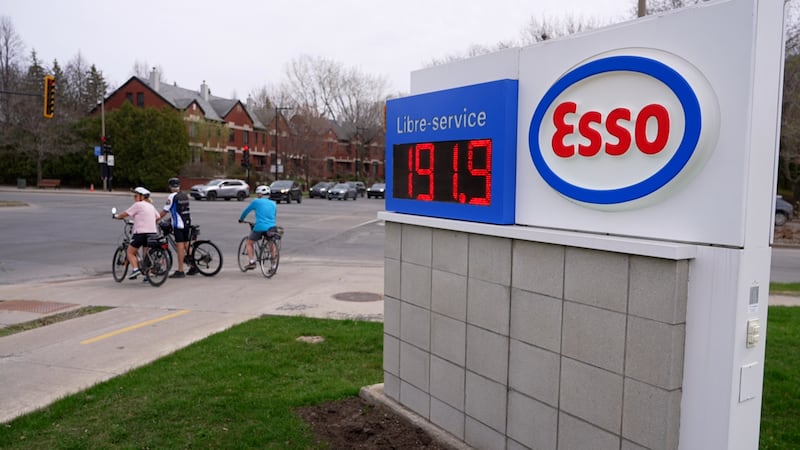
Many drivers say with the cost of everything rising, any saving helps. Cutting the tax is one small way to help, but it is still small comfort.
“Ten cents a litre isn’t much,” said taxi driver Nouradina Hassan.
But the path to a significant drop in prices isn’t clear.
The United Arab Emirates announced Tuesday it would pull out of OPEC, the oil exporting group, and has expressed its desire to pump out more oil. But analysts say gauging what this could mean for prices is difficult for now. Gitane De Silva, the former CEO of the Canada Energy regulator, says it will take time before the move has any impact.
“This is just a decision to withdraw from a quota setting organization,” said De Silva. “The UAE wants to increase its output, but that’s going to take time. Of course, getting into the market is still a real challenge because of the blockade of the Strait of Hormuz. So, the volatility and unfortunately the sustained high prices are going to last for a while.”

