


A senior adviser to U.S. President Donald Trump shared harsh words against Canada’s potential auto trade expansion with China.
“Are u really threatening to play China off the U.S.? This is offensive in the extreme. You should be far more worried China is going to eat Canada alive--as it is already doing. Vancouver is not BC, its PRC,” said Peter Navarro, trade adviser to Trump, in what he called a “memo” to Prime Minister Mark Carney. Pete Hoekstra, Washington’s ambassador to Canada, reshared the post.
Carney is in Shenzhen, China, this week for the Asia-Pacific Economic Cooperation summit. On the sidelines of the event, he met with that country’s president, Xi Jinping. The two leaders agreed to lower tariffs on frozen pork and seafood, according to a readout of the exchange. More than 90 per cent of Canada-China trade is now on reduced tariffs, it said.
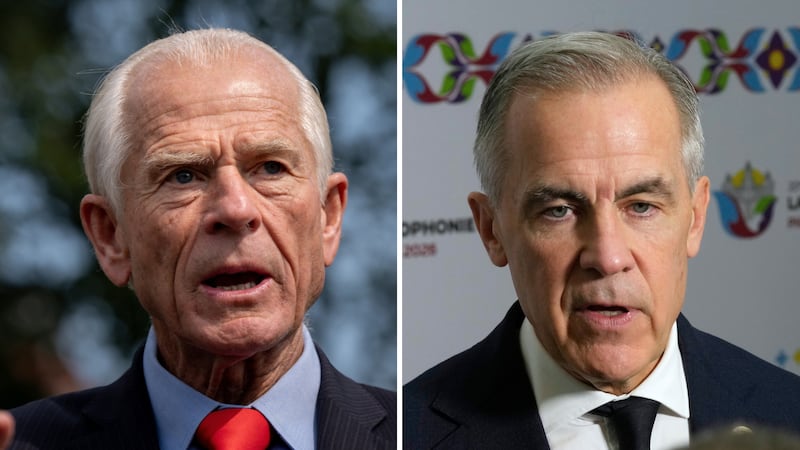
But if and how Canada and China expand auto trade has been a source of friction domestically and internationally. Navarro posted his statement in response to an Associated Press article quoting Carney’s suggestion that Canada could seek greater Chinese involvement in the domestic auto sector.
“We have the best autoworkers in the world, and we want them fully deployed … in an integrated north American market,” Carney told reporters in Cambodia. “That market has become less integrated because of U.S. trade actions.”
Auto tariffs
Throughout Trump’s second term in office, Canada and the U.S. have traded tariff barbs as part of a larger trade war.
U.S. President Donald Trump has imposed 25 per cent tariffs on auto imports from north of the border, with exemptions for content that fits into the two country’s existing trade deal, the Canada-U.S.-Mexico Agreement (CUSMA). Canada retaliated with its own 25 per cent fees. In August, Trump threatened to raise tariffs on Canadian-made vehicles and auto parts to 50 per cent, effective Jan. 1, 2027.
The two countries share a deeply integrated auto manufacturing sector, which Carney called “the best result” for Canadian workers, businesses, and U.S. consumers. But the makeup of that sector depends on trade talks.
“Depending on where that settles, and it’s part of the trade negotiations … there will be other options, European options, Asian options. Of course, Chinese, Japanese,” he said.
Asked if he considers a potential auto deal with China as leverage in trade talks with the U.S., Carney said it was not, but “action, reaction.”
Trump has repeatedly said that the U.S. does not need Canadian-manufactured automobiles. He’s been forthright with his intention to reshore auto manufacturing within the United States, using tariffs as a lever to carry out that vision.
North of the border, Stellantis, a key player in that cross-border manufacturing chain, is reducing its footprint.
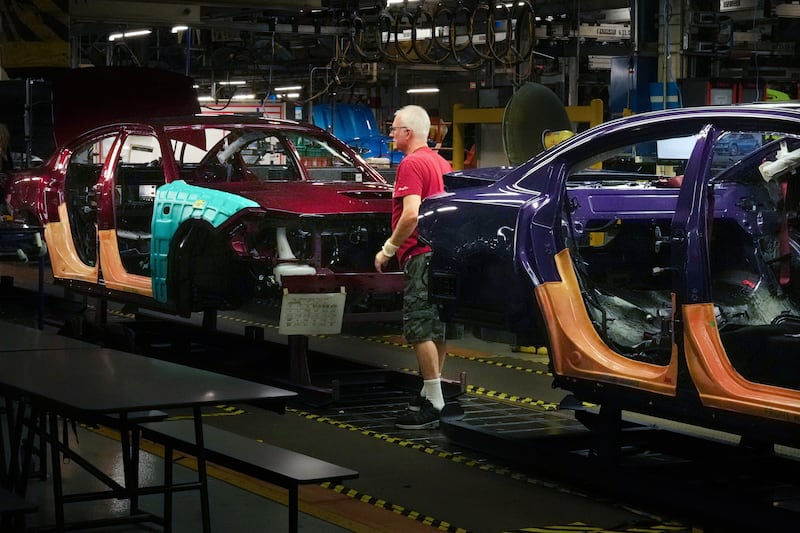
Stellantis had plans to retool its Brampton, Ont., assembly plant to produce the Jeep Compass electric SUV. The company halted that work after Trump began rolling out tariffs in 2025. It later said that production line would move to Illinois as part of its US$13-billion plan to expand U.S. production by 50 per cent.
Speaking alongside striking workers on Monday, NDP Leader Avi Lewis called the plant an essential piece of Canada’s industrial economy.
“Once we lose this industrial capacity, it is gone. It doesn’t come back. This tariff war is an attack on Canada and Donald Trump wants to de-industrialize this country,” he said.
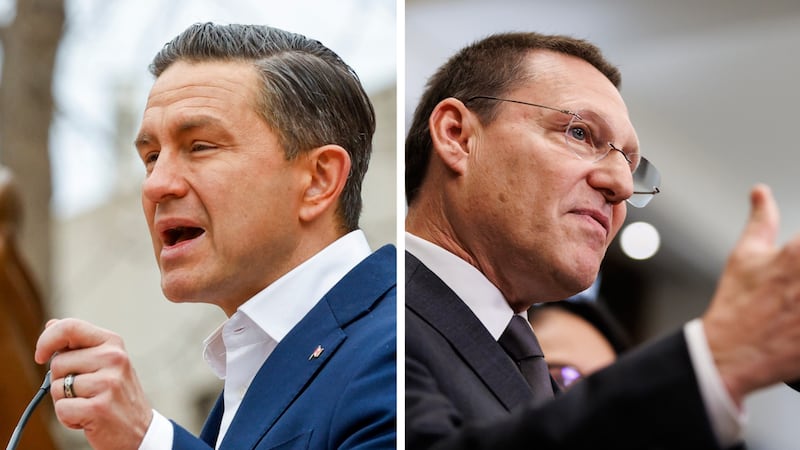
Conservative Leader Pierre Poilievre has called on Carney to fire Industry Minister Melanie Joly over her handling of the Stellantis plant, which could soon be sold to Canadian armoured vehicle manufacturer Roshel.
Canada open to Chinese business
The federal government appears open to Chinese EVs being manufactured in Canada.
In June, after meeting with four Chinese car manufacturers, Joly told reporters that all the companies she met with are “willing to explore creating joint ventures in Canada in order to produce in Canada.”
The minister stipulated any arrangement would have to meet conditions, including a localized supply chain and Canadian control of the joint venture.
International Trade Minister Maninder Sidhu visited one of those Chinese automakers, Chery, and posted online that he had done so “to discuss their upcoming models and hear about their plans to introduce affordable EVs to Canadians.”
In January, Carney announced a deal with Beijing to allow up to 49,000 Chinese EVs into Canada each year at a 6.1 per cent tariff. Canada had previously imposed a 100 per cent tariff in line with U.S. levies. In exchange, China would drop its tariffs on a number of Canadian agriculture products, including canola seeds and meal, some seafood and peas.
Since then, Canadian exports to China have surged.
Statistics Canada reported this week that, in the first nine months of 2026, Canada’s exports rose 40 per cent to reach $33.5 billion – a rate that far outpaces growth in exports to any other nation, according to the federal government.
China’s exports to Canada, in contrast, did not grow at the same rate. Between January and September, Canada imported $68.8 billion in Chinese goods, about $700 million more than in the same period a year earlier.
Carney’s ‘very fine line’
Navarro’s comments suggest Canada’s proximity to China could lead to “stormy waters” during CUSMA negotiations, according to one analyst.
“I think Mr. Carney is walking a very fine line,” Carlton University Sprott School of Business Prof. Ian Lee told CTV News Channel on Tuesday. “He’s got to be very careful not to further antagonize or alienate the United States.”
The state of CUSMA negotiations between Canada and the U.S. is largely opaque. Both countries have aired their grievances – among them, Ottawa wants sovereignty over its own international trade, the U.S. wants more market access in protected industries – but where negotiators have found common ground is less clear.
At the core of free trade negotiations, Lee contends, is the future of the cross-border auto manufacturing industry. CUSMA rules require autos to be built using a minimum quantity of local materials and labour.
“Whatever we think about Navarro, he is speaking – certainly – a view that we’ve heard many times from Mr. Trump.”
Navarro’s note mirrors similar language from Trump, who said in January that China would “’eat them up’ within the first year” of expanded trade.
“China is successfully and completely taking over the once Great Country of Canada. So sad to see it happen. I only hope they leave Ice Hockey alone!” he also wrote on Truth Social.
With files from CTV News’ Vassy Kapelos and Marieke Walsh, and The Canadian Press

