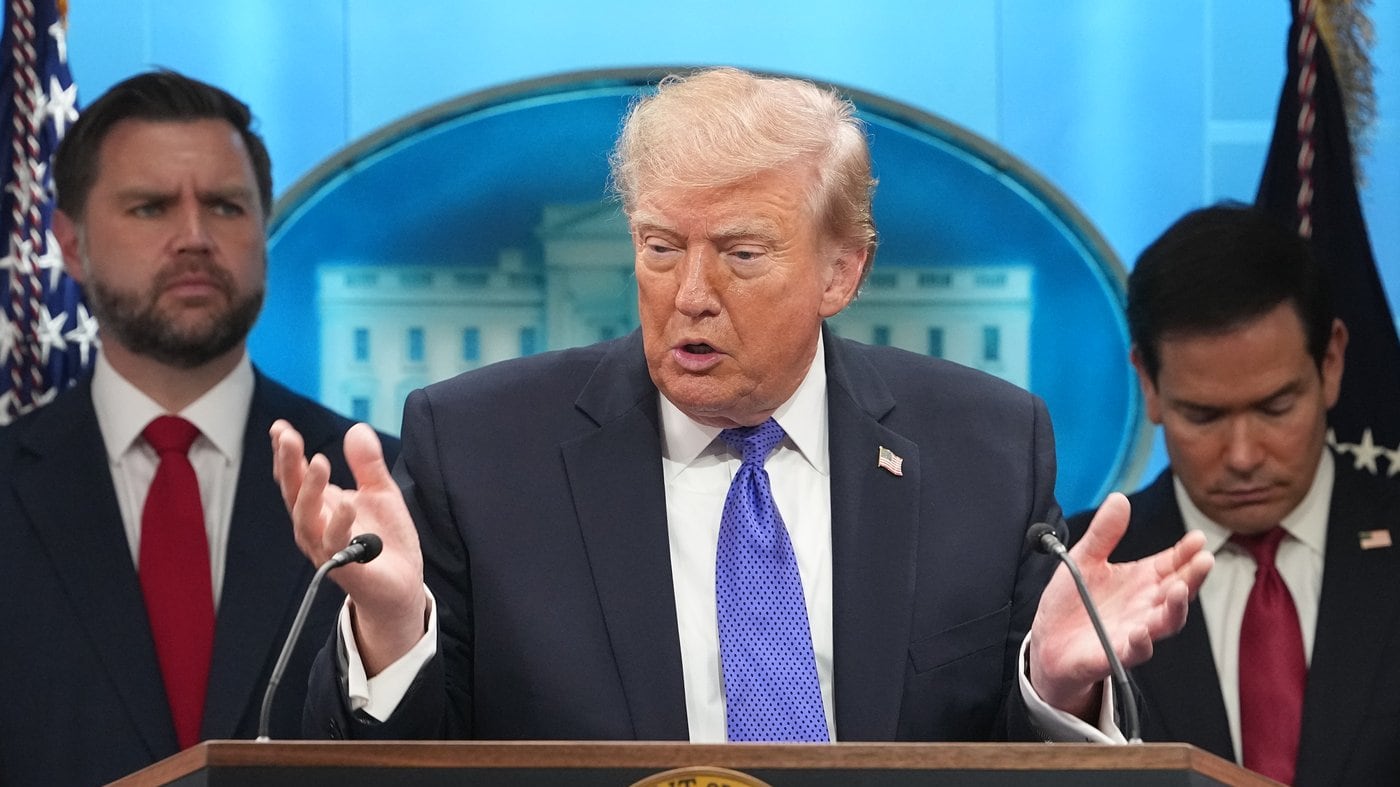
WASHINGTON — U.S. President Donald Trump said Friday Canada is feeling “emboldened” but his administration is working on a trade deal “that’s fair.”
In a wide-ranging news conference at the White House, the president said he spoke with Prime Minister Mark Carney on the sidelines of the Asia-Pacific economic summit in Shenzhen, China, and described the Canadian leader as “very nice.”
Trump then turned to his repeated claims about Canada ripping off the United States and being frustrating to deal with on the trade file.
“For some reason they feel emboldened and we can’t let them feel that way anymore,” Trump said.
It wasn’t clear exactly what the president was referring to — the historically close Canada-U.S. relationship or the midterm elections which saw American voters issue a clear rebuke of Trump’s trade policy and sweeping tariff campaign.
Trump’s trade war with Canada rapidly escalated after negotiations broke down in August. The president hit an array of Canadian goods with 50 per cent tariffs and banned imports of others, prompting Ottawa to respond with retaliatory duties.
Trump also signed an executive order to rename Lake Ontario as Lake America, and spent days posting images on social media disparaging Canada.
The Trump administration’s tone on Canada softened somewhat after the Republican shellacking in the midterm elections.
On Nov. 12, United States Trade Representative Jamieson Greer said “we want to have a deal that makes sense for them and for us.”
“Part of it means protecting our supply chains and getting them here, but also making accommodation when possible,” Greer said.
Trump said Friday that when Canada’s trade deficit with the United States is down to zero, he’ll be ready to talk. That trade deficit is driven by U.S. consumption of oil and energy products, which Trump also has said he wants to increase.
The president repeated Friday the claim that Carney wants to “build a Keystone pipeline for us” — likely a reference to the Prairie Connector pipeline that would reuse Keystone XL infrastructure.
Carney on Wednesday said a “very good trade arrangement” with the United States is possible but Canada won’t just sit around and wait. Carney has embarked on a mission to reduce Canada’s reliance on the United States, including signing trade deals last week with the Philippines and the Association of Southeast Asian Nations group.
“We’d like to do a deal. If the U.S. doesn’t want to do a deal, we’re busy,” Carney said in an interview during the New York Times DealBook Summit on Wednesday.
Canada’s Chief Trade Negotiator Janice Charette has said Canada must prepare for a world where a tariff-free arrangement may no longer be possible.
The objective is to “get to the lowest rate of tariff on the narrowest basket of goods with the most preferential access for Canadian businesses and Canadian workers,” Charette told MPs during a meeting Tuesday of the House of Commons international trade committee in Ottawa.
Democrats have indicated ending the trade war with Canada will be among their top priorities when they take control of Congress in January — but they could struggle to achieve the supermajority they need to override the president’s veto.
Canada will also need to continue working with the Trump administration to renew the Canada-U.S.-Mexico Agreement on trade, better known as CUSMA.
Trump did not renew CUSMA in July, triggering a rolling annual review for up to a decade — at which point the agreement will expire if the three countries cannot agree on an extension.
During Friday’s nearly 90-minute press briefing where Trump praised Chinese President Xi Jinping and Russian President Vladimir Putin, the president also said companies that build artificial intelligence data centres in other countries will be hit with “a tremendous tax.”
“We’re not allowing data centres to go into other countries because China will take all of them, and we’re not allowing that to happen,” Trump said. “And we’re going to put tremendous penalties on companies that try and do it.”
Trump said he hadn’t yet told his own officials about his plan and offered no details. Throughout the president’s second term he has suggested tariffs and punishments for a wide range of actions that have never materialized.
Unease over the fast pace of data centre development in the U.S. also helped Democrats win big in the midterm elections.
Kelly Geraldine Malone, The Canadian Press

