In an industrial park in Austin, Texas, behind glass doors that look like any other corporate office, Amazon is building one of the most important businesses in technology.
Some investors haven’t noticed yet. But they will soon.
We spent a day inside Annapurna Labs, where Amazon designs incredibly powerful and cost effective chips for its Amazon Web Services customers. Not only are Amazon’s efforts helping to democratize AI, the company is quickly becoming a credible rival to longtime partner Nvidia.

Its custom chip business is now running at more than US$20 billion a year, growing at triple-digit rates. That’s bigger than many of the most-watched names in tech, hiding in plain sight inside a company most investors still think of as a retail and cloud business.
Amazon CEO Andy Jassy summed it up in his most recent shareholder letter: “Our chips business is on fire.”
The acquisition nobody noticed
In 2015, Amazon paid a reported US$350 million for a small Israeli chip design firm called Annapurna Labs. The deal barely made the news.
At the time, almost nobody asked why Amazon, a company not generally known for making hardware, was suddenly buying a chip business.
The answer, more than a decade later, is clear. And some now view the acquisition as one of the smartest deals Amazon ever made.
Annapurna’s engineers, working alongside teams in Austin and other Amazon design centres, have built three families of custom chips that now sit at the heart of Amazon Web Services. Graviton, a general-purpose processor that competes with Intel and AMD. Nitro, the chip that runs the internal plumbing of the AWS cloud. And Trainium, the family of AI chips designed to train and run the largest models in the world.
Trainium is the one drawing the comparisons to Nvidia.
Inside the lab
Walking through the Annapurna space in Austin, the first thing that strikes you is how unassuming it is. There are no sparks, no smoke, no clean rooms. The actual fabrication of these chips happens elsewhere, at TSMC’s plants in Taiwan. What happens in Austin is design.
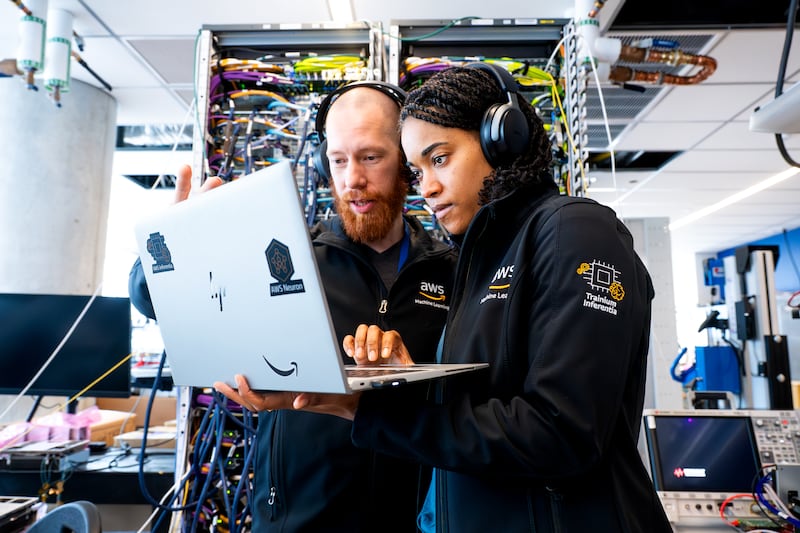
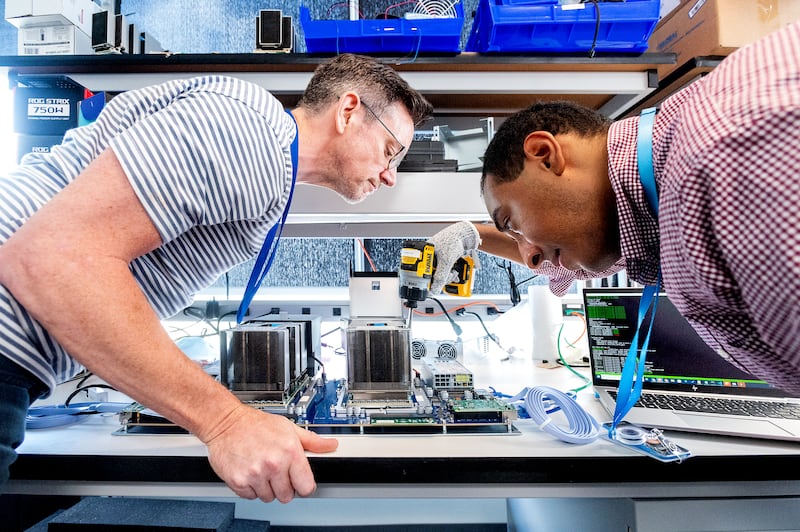
That means engineers at workstations. Whiteboards covered in diagrams. Test rigs, where prototype chips are pushed through their first runs before they’re sent off to be manufactured at scale.
During our tour, my Ticker Take co-host Caroline Lesley asked Kris King, Senior Software Development Manager and Director of the Austin Annapurna Labs, about a set of small dots she had noticed on one of the chips. They turned out to be voltage probes: tiny test points engineers use to verify that current is flowing through the chip exactly the way it was designed to. The detail was, on its face, mundane. But it captures something important about the work. It is painstaking, deeply specialized, and almost invisible to the outside world.

Ron Diamant, the chief architect of Trainium and the person most responsible for the way these chips are designed, relished the question. This is a team that has eagerly and excitedly committed itself to delivering the most common ask among AWS customers: offer powerful chips that are equally cost effective.
At another point, King held up a Trainium3 chip next to its predecessor. To the eye, the two look almost identical. But the silicon technology inside shrank from 5 nanometers to 3 nanometers, allowing Amazon’s engineers to pack significantly more logic and functionality into the same footprint. The result was a 4.4 times jump in performance, generation over generation.
Why it matters
The reason Amazon got into the chip business in the first place is simple economics. AWS, Amazon’s cloud business, was buying enormous quantities of chips from outside vendors. The more Amazon could design and produce its own, the lower its costs would be, and the more efficient its cloud could become.
For a long time, that was largely a story about cost. Graviton and Nitro made AWS faster and cheaper to run. The savings showed up in margins.
Trainium changes the story
Trainium is an AI chip. It is designed specifically to train and run the large language models that have come to define the current technology cycle. And it is being adopted by some of the most important names in artificial intelligence.
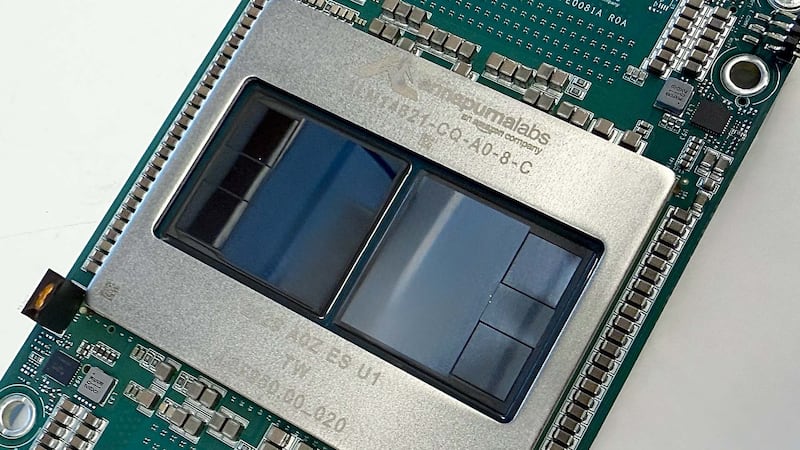
Anthropic, the maker of the Claude AI assistant, runs Claude on more than a million of Amazon’s Trainium2 chips. The two companies are partners in a project called Rainier, a massive new compute cluster built specifically for AI training. OpenAI, long synonymous with Microsoft’s cloud, has signed on for two gigawatts of Trainium capacity. Apple uses some of Amazon’s chips too, though it runs its own consumer AI on chips it designs itself.
The performance numbers help explain why. Trainium3, Amazon’s newest generation of AI chip, can deliver up to four times the performance of the previous version. And Amazon doesn’t sell these chips. It rents them, by the hour, through AWS. That keeps customers inside the AWS ecosystem and produces recurring revenue, not a one-time hardware sale.
The Nvidia question
The temptation, looking at all of this, is to ask whether Amazon is in a position to potentially dethrone the leading AI chip player, Nvidia. After all, its commitment to innovation and customer satisfaction has already made it one of the world’s most valuable companies.
The honest answer, though, is no.

Ron Diamant, the chief architect of Trainium and a Vice President and Distinguished Engineer at AWS, put it plainly when we sat down with him in Austin.
“We’re not trying to replace Nvidia,” he said. “Here at Amazon, we see ourselves as the everything store. So we’ll offer Nvidia, and we’ll offer Trainium, for many years to come. The Nvidia partnership has been great. They build fantastic chips.”
Nvidia still dominates the AI chip market. Its CUDA software platform has become the default for AI development worldwide. Most of the companies using Trainium also buy plenty of Nvidia chips, and will keep doing so for years. The collaboration runs both ways. Nvidia itself recently invested US$10 billion in Anthropic, Amazon’s own AI partner.
What Amazon is doing is different. By offering its own chips alongside Nvidia’s, AWS gives customers more choice, better pricing flexibility, and an alternative they can lean on if Nvidia supply gets tight or expensive. For Amazon itself, owning the chip means owning more of the margin.
It’s not winner-take-all. It’s a race to control cost.
What it means for investors
The spending we’ve seen by tech giants during the AI boom is unprecedented. And in some cases, nerve-racking to investors.
In the case of Amazon, it plans to lay out roughly US$200 billion in capital expenditures this year, much of it on the data centres and chip capacity needed to run all of the above.
But Amazon remains one of the most beloved stocks on Wall Street. And that big spending could have a big payoff.

Consider margins. The more chips Amazon designs in-house, the less it has to buy from outside vendors. Jassy, in his 2025 shareholder letter, said Trainium could save the company tens of billions of dollars in capital spending a year. There’s the customer satisfaction angle. Amazon is aggressively rolling out AI chips to give its long list of AWS clients — including Meta, Uber, Stripe, Snap Inc, Pinterest and Lyft — more cost effective options to keep their own AI spending bills down.
And it’s worth highlighting Anthropic. Amazon has invested about US$8 billion in the AI company, in a series of deals stretching back several years. That stake is now estimated to be worth roughly US$74 billion. Anthropic recently filed to go public. If the IPO performs anything like SpaceX’s did, it could be one of the largest tech listings in years.
Over the past two decades, Amazon stock has returned roughly 15,000 per cent, placing it among the top five performers in the Nasdaq 100. The chip business could help to keep that streak of outperformance going.
There is one more variable worth watching.
Today, Amazon makes money from these chips by renting them out to its AWS customers. The revenue flows through the cloud business. But Jassy himself has floated what the chip business could look like if it ever stood on its own: a roughly US$50 billion enterprise, hypothetically, if Amazon were to sell chips to outside customers.
When we asked Ron Diamant whether Amazon could one day go that direction, his answer was open-ended.
“We’re constantly having these discussions,” he said. “At the end of the day, what we want to do is provide maximum customer value, and there’s more than one way to do that. We can rent these chips hourly, yearly, or on a multiyear contract through AWS, or we can deliver servers to our customers. We’re looking into it. We don’t have anything to announce just yet, but we’ll do whatever it takes to provide the most value to our customers.”
Back in the lab
Standing in front of a rack of Trainium servers in Austin, it’s easy to forget the scale of what these chips are powering. They look like ordinary computer components. Black boxes, fans, cables.
But the same chips designed in that quiet lab are training Claude. They are running a piece of OpenAI’s infrastructure. They are powering, in one form or another, a large fraction of the AI tools becoming part of daily life.
Amazon is not a chipmaker in the traditional sense. It does not run fabrication plants. It does not sell chips to consumers. It does not put its name on the front of a server box.
But quietly, deliberately, and with the kind of patience that has long defined the company, it has built a chip business large enough to change the conversation. And in the AI era, that might turn out to be the most valuable thing it does.
Jon Erlichman is a BNN Bloomberg contributor and the host of Ticker Take on YouTube.

