
When Canadians invest in the U.S. stock market, they often default to buying an exchange-traded fund (ETF) that represents the S&P 500.
There are a lot of choices when selecting S&P 500 ETFs that investors can buy, including the venerable State Street SPDR S&P 500 ETF Trust (SPY) that trades in the U.S. market.
Canadians can also choose one of the many S&P 500 ETFs from Canadian providers. Canadian investors have the additional choice of choosing currency hedged or unhedged S&P 500 ETFs.
Since the Global Financial Crisis in 2008, investing in a S&P 500 capitalization weighted index (cap weighted index), such as the SPY ETF, has proven to be a good choice as large companies have outperformed smaller companies.
The S&P 500 is largely dominated by the performance of large companies such as Apple, Microsoft and Nvidia. Apple has an approximate eight per cent weight in the S&P 500, while both Microsoft and Nvidia have an approximate six per cent weight.
A cap weighted index weights each company in the index according to the company’s capitalization, compared to the total capitalization of all the companies in the index. Companies with a larger market value have a greater weight in the index.
There is another alternative to investing in the S&P 500 and that is to invest in an equal weight S&P 500 ETF, such as the Invesco S&P 500 Equal Weight ETF (RSP) that trades on the U.S. stock market.
With the equal weight S&P 500, each company would have an approximate weight of 0.2 per cent. In addition, the sector allocation would change, and the technology sector weight would be reduced to approximately 15 per cent from 34 per cent. The result is a greater diversification by weights and sectors.
In general, when the stock market is heading higher or lower, both the capitalization weighted S&P 500 and the equal weighted S&P 500 rise and fall together, but by different amounts.
There will be times where one index rises and the other falls. In the graph below, the S&P 500 is represented by the yellow line, and the S&P 500 equal weight index is represented by the blue line.
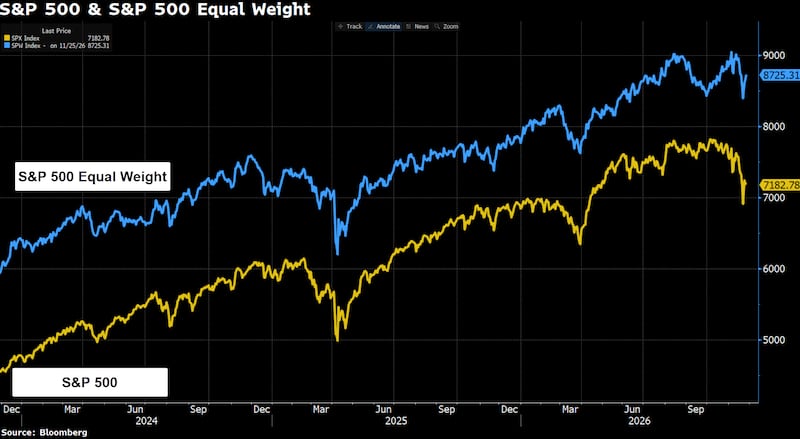
Large company performance dominates the behaviour of the S&P 500, especially in the technology sector.
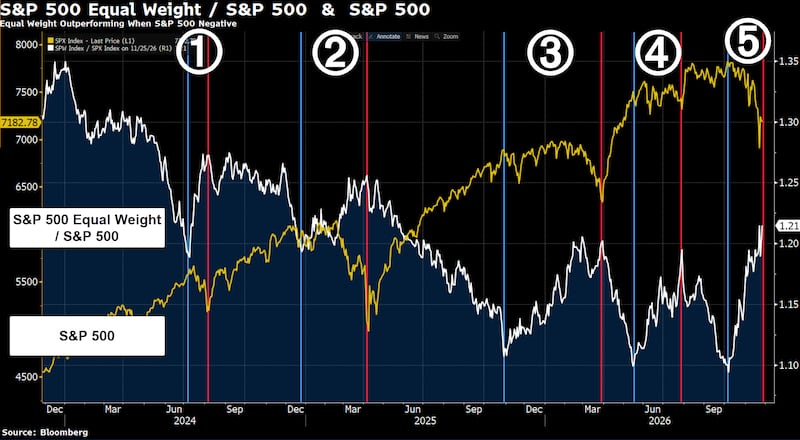
The graph below shows the performance of the S&P 500 (yellow line) and the relative performance of the S&P 500 Equal Weight Index versus the S&P 500 (white line).
In recent years we have seen that when the S&P 500 has been rising it tends to outperform the equal weight S&P 500 index. When the S&P 500 is declining, it tends to underperform the equal weight S&P 500 index.
In the graph below, the blue vertical line represents the start of a period of outperformance by the equal weighted index, and the red line represents the end of the outperformance.
The periods are numbered 1 to 5. In all of these cases, the S&P 500 declined. In other words, the equal weighted index helped to buffer the downside compared to the S&P 500.
There are advantages and disadvantages to investing in either a capitalization or equal weight index. Both will outperform and underperform at different times.
Currently, the technology sector is stumbling as investors are questioning the durability of the AI trade. As a result, the technology sector is underperforming, which has led to the outperformance of the equal weighted S&P 500 index.
Since September of this year, the equal weight S&P 500 index has been outperforming and will likely continue to outperform if the technology sector continues to stumble.
The views and opinions expressed herein are solely those of the author(s) and may not necessarily reflect the views of Global X Investments Canada Inc. All comments, opinions and views expressed are generally based on information available as of the date of publication and should not be considered advice to purchase or sell any securities mentioned. Before making any investment decision, please consult your investment advisor or advisors.